BTGmoderatorDC wrote: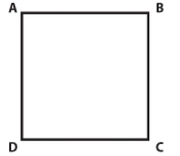
Square ABCD has an area of 9 square inches. Sides AD and BC are lengthened to x inches each. By how many inches were sides AD and BC lengthened?
(1) The diagonal of the resulting rectangle measures 5 inches.
(2) The resulting rectangle can be cut into three rectangles of equal size.
OA
A
Source: Manhattan Prep
Given that the square ABCD has an area of 9 square inches, we have AD = BC = 3 inches. Thus, the increased length of AD and BC is AD' and BC' = (3 + x) inches.
We have to determine the value of x.
Let's take each statement one by one.
(1) The diagonal of the resulting rectangle measures 5 inches.
For the rectangle ABC'D', the length of the diagonal = √[(AD')^2 + (AB)^2] = √[(3 + x)^2 + (3^2)] = 5
(3 + x)^2 + (3^2) = 5^2
(3 + x)^2 + 9 = 25
(3 + x)^2 = 25 - 9
(3 + x)^2 = 16
x = 1
Sufficient.
(2) The resulting rectangle can be cut into three rectangles of equal size.
Say x = 4, the length of each rectangle 7/3, and the area of each of the three rectangles would be 7/3*3 = 7 sq inches. However, x = 6, the length of each rectangle 9/3 = 3, and the area of each of the three rectangles would be 3*3 = 9 sq inches. No unique answer. Insufficient.
The correct answer:
A
Hope this helps!
-Jay
_________________
Manhattan Review GMAT Prep
Locations:
GMAT Classes Philadelphia |
GMAT Tutoring San Diego |
GRE Prep Austin |
TOEFL Prep Classes Portland | and many more...
Schedule your free consultation with an experienced GMAT Prep Advisor!
Click here.























