BTGmoderatorDC wrote:In the below addition A, B, C, D, E, F, and G represent the digits 0, 1, 2, 3, 4, 5 and 6. If each variable has a different value, and E ≠0, then G equals
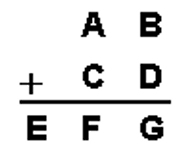
A. 2
B. 3
C. 4
D. 5
E. 6
If we add two 2-digit numbers and the sum is a 3-digit number, then the 3-digit number must start with a 1.
So,
E = 1
In order for the sum to be a 3-digit number, A+C must be greater than 9
So, we have two options:
EITHER A and C are 5 and 6, OR A and C are 4 and 6
If A and C are 5 and 6, then F = 1, but we already know that E = 1
So, it MUST be the case that
A and C are 4 and 6, which means
F = 0
The three digits unaccounted for are 2, 3 and 5
Since we can see that B + D = G, it must be the case that
G = 5
Answer: D
Cheers,
Brent
Brent Hanneson - Creator of GMATPrepNow.com
























