BTGmoderatorDC wrote: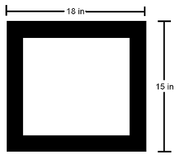
The shaded region in the figure above represents a rectangular frame with length 18 inches and width 15 inches. The frame encloses a rectangular picture that has the same area as the frame itself. If the length and width of the picture have the same ratio as the lenght and width of the frame, what is the length of the picture, in inches?
A. \(9\sqrt2\)
B. \(\frac {3}{2}\)
C. \(\frac {9}{\sqrt2}\)
D. \(15 ( 1 - \frac {1}{\sqrt2})\)
E. \(\frac {9}{2}\)
ALTERNATE SOLUTION:
IMPORTANT: the diagrams in GMAT problem solving questions are DRAWN TO SCALE unless stated otherwise.
So, we can use this fact to solve the question by simply "eyeballing" the diagram.
See our video below on this topic as well as other assumptions we can make about diagrams on the GMAT
If you had to ESTIMATE the length of the picture, what would you say it is?
12? 13? 14? 15?
As long as you're in this range, you should be able to solve this one.
ASIDE: On test day, you should have memorized the following approximations:
√2 ≈ 1.4
√3 ≈ 1.7
√5 ≈ 2.2
Now let's check the answer choices....
A. 9√2 ≈ (9)(1.4) ≈ 13. This is within our estimated
range. KEEP
B. 3/2 = 1.5. This is WAYYYY outside our estimated
range. ELIMINATE
C. 9/√2 ≈ 9/1.4 ≈ 6. This is WAYYYY outside our estimated
range. ELIMINATE
D. 15(1 - 1/√2) ≈ 15(1 - 0.7) ≈ (15)(0.3) ≈ 4.5. This is WAYYYY outside our estimated
range. ELIMINATE
E. 9/2 = 4.5. This is WAYYYY outside our estimated
range. ELIMINATE
Answer: A
Brent Hanneson - Creator of GMATPrepNow.com



























