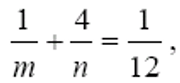
This problem seems beyond the scope of the GMAT.
That said, here is one approach:
1/m = 1/12 - 4/n.
Since m must be positive, 1/12 must be greater than 4/n:
1/12 > 4/n
n > 48.
Since n must be an odd integer less than 60, test odd integers between 48 and 60 to see which yield integer values for m.
n=49:
1/m = 1/12 - 4/49
1/m = 1/(12*49)
Here, m = 12*49.
n=51:
1/m = 1/12 - 4/51
1/m = 3/(12*51)
1/m = 1/(4*51).
Here, m = 4*51.
n=53:
1/m = 1/12 - 4/53
1/m = 5/(12*53).
Here, m is not an integer.
n=55
1/m = 1/12 - 4/55
1/m = 7/(12*55).
Here, m is not an integer.
n=57:
1/m = 1/12 - 4/57
1/m = 9/(12*57)
1/m = 1/(3*19).
Here, m = 3*19.
n=59:
1/m = 1/12 - 4/59
1/m = 11/(12*59).
Here, m is not an integer.
Only the 3 options in red are viable.
The correct answer is B.
Private tutor exclusively for the GMAT and GRE, with over 20 years of experience.
Followed here and elsewhere by over 1900 test-takers.
I have worked with students based in the US, Australia, Taiwan, China, Tajikistan, Kuwait, Saudi Arabia -- a long list of countries.
My students have been admitted to HBS, CBS, Tuck, Yale, Stern, Fuqua -- a long list of top programs.
As a tutor, I don't simply teach you how I would approach problems.
I unlock the best way for YOU to solve problems.
For more information, please email me (Mitch Hunt) at
[email protected].
Student Review #1
Student Review #2
Student Review #3