


Timer
00:00
Answers
A
B
C
D
E
Stats
Difficulty—
Source: Magoosh
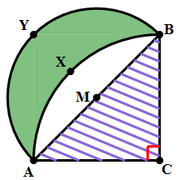
In the diagram above, angle \(C=90^o\) and \(AC=BC\). Point \(M\) is the midpoint of \(AB\). Arc \(AXB\) has its center at \(C\) and passes through \(A\) and \(B\). Arc \(AYB\) has its center at \(M\) and passes through \(A\) and \(B\). The shaded region between the two arcs is called a "lune". What is the ratio of the area of the lune to the area of triangle \(ABC\)?
A. \(1\)
B. \(\frac{\pi}{2}\)
C. \(\frac{\pi}{3}\)
D. \(\frac{3\pi}{8}\)
E. \(\frac{4\pi}{9}\)
The OA is A
In the diagram above, angle \(C=90^o\) and \(AC=BC\). Point \(M\) is the midpoint of \(AB\). Arc \(AXB\) has its center at \(C\) and passes through \(A\) and \(B\). Arc \(AYB\) has its center at \(M\) and passes through \(A\) and \(B\). The shaded region between the two arcs is called a "lune". What is the ratio of the area of the lune to the area of triangle \(ABC\)?
A. \(1\)
B. \(\frac{\pi}{2}\)
C. \(\frac{\pi}{3}\)
D. \(\frac{3\pi}{8}\)
E. \(\frac{4\pi}{9}\)
The OA is A




















