Hi AAPL,
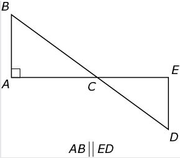
First thing to recognize is that triangles ABC and CDE are similar(Why?).
Also, notice that triangle CED is a 30-60-90 triangle because short side is of length 1 and the hypotenuse is 2. That means CE= sqrt{3} and therefore AC= 5*sqrt{3} . From the ratios of sides in a 30-60-90 triangle, we obtain AB=5 and BC=10, and the perimeter of triangle ABC is equal to 15+5*sqrt{3} .
Cheers,
Dabral
BREAKING: Target Test Prep releases Brand New 2026 On Demand GMAT prep course
Redeem
Target Test Prep GMAT OnDemand
Scott Woodbury-Stewart’s private virtual classroom — 400 hours of master-class video lessons for the GMAT Focus Edition.
- 715+ score guarantee — highest in the industry (99th percentile)
- 52 chapters · 1,500+ lessons · 4,000+ practice questions
- 400 hours of video · 1,500+ instructor-led HD smartboard lessons
- 300,000+ students accepted to Harvard, Stanford, Wharton, Booth & Sloan & more
- 24/7 live support + weekly Zoom office hours with GMAT instructors
- TTP AI Assist — 24/7 AI-powered virtual tutor for instant help
- 1,200+ flashcards + AI-powered study assistant & daily calendar
- OnDemand, LiveTeach & GMAT Bootcamp formats available
- Also: GRE, SAT Math & Executive Assessment courses
- MBA Admissions Consulting now available
- 🏆 2025 EdTech Breakthrough Award: Test Prep Solution Provider of the Year
- 200,000+ students served
- 5-day free trial — $0 to start, no auto-billing, cancel anytime
★★★★★
5.0
(559 reviews)
130-pt guarantee
$0 to start
then $127/mo
What is the perimeter of Δ ABC ?
Source: Beat The GMAT — Problem Solving |
Hello.
Using the Pythagora's Theorem we can find CE. $$CE=\sqrt{2^2-1^2}=\sqrt{3}.$$
Now, AE=AC+CE, this implies that: $$AC=AE-CE=6\sqrt{3}-\sqrt{3}=5\sqrt{3}.$$
To calculate AB, we will use that triangles ABC and EDC are similar. So, $$\frac{AB}{ED}=\frac{AC}{CE},\ this\ implies\ that,\ \frac{AB}{1}=\frac{5\sqrt{3}}{\sqrt{3}},\ that\ is,\ AB=5.$$
Now, we can calculate BC using the Pythagora's Theorem again. We will get, $$BC=\sqrt{5^2+\ \left(5\sqrt{3}\right)^2}=\sqrt{25+75}=\sqrt{100}=10.$$
In conclusion, the perimeter of ABC is $$15+5\sqrt{3}.$$
The correct answer is D.
I hope this can help you.
Feel free to ask me again if you have any doubt.
Using the Pythagora's Theorem we can find CE. $$CE=\sqrt{2^2-1^2}=\sqrt{3}.$$
Now, AE=AC+CE, this implies that: $$AC=AE-CE=6\sqrt{3}-\sqrt{3}=5\sqrt{3}.$$
To calculate AB, we will use that triangles ABC and EDC are similar. So, $$\frac{AB}{ED}=\frac{AC}{CE},\ this\ implies\ that,\ \frac{AB}{1}=\frac{5\sqrt{3}}{\sqrt{3}},\ that\ is,\ AB=5.$$
Now, we can calculate BC using the Pythagora's Theorem again. We will get, $$BC=\sqrt{5^2+\ \left(5\sqrt{3}\right)^2}=\sqrt{25+75}=\sqrt{100}=10.$$
In conclusion, the perimeter of ABC is $$15+5\sqrt{3}.$$
The correct answer is D.
I hope this can help you.
Feel free to ask me again if you have any doubt.

GMAT Prep From The Economist
We offer 70+ point score improvement money back guarantee.
Our average student improves 98 points.

We offer 70+ point score improvement money back guarantee.
Our average student improves 98 points.