BTGmoderatorDC wrote: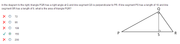
In the diagram to the right, triangle PQR has a right angle at Q and line segment QS is perpendicular to PR. If line segment PS has a length of 16 and line segment SR has a length of 9, what is the area of triangle PQR?
A. 72
B. 96
C. 108
D. 150
E. 200
OA
D
Source: Manhattan Prep
Area of triangle PQR = 1/2*PQ*QR
We know that PR = PS + SR = 16 + 9 = 25
In the right-angled ∆PQR, we have PR^2 = PQ^2 + QR^2 => PQ^2 + QR^2 = 25^2 ---(1)
From right-angled ∆PQS, we have PQ^2 = PS^2 + QS^2 => PQ^2 - PS^2 = QS^2 => PQ^2 - 16^2 = QS^2 ---(2)
From right-angled ∆PSR, we have QR^2 = SR^2 + QS^2 => QR^2 - SR^2 = QS^2 => QR^2 - 9^2 = QS^2 ---(3)
Since (2) = (3), we have PQ^2 - 16^2 = QR^2 - 9^2 => PQ^2 - QR^2 = 16^2 - 9^2 => PQ^2 - QR^2 = 175 ---(4)
From (1) PQ^2 + QR^2 = 25^2 and (2) PQ^2 - QR^2 = 175, we have PQ = 20 and QR = 15
Thus, the area of triangle PQR = 1/2*PQ*QR = 1/2*20*15 = 150
The correct answer:
D
Hope this helps!
-Jay
_________________
Manhattan Review GMAT Prep
Locations:
Manhattan Review GMAT Prep |
Free SAT Practice Questions |
LSAT Prep Courses Oxford |
SAT Prep Courses Singapore | and many more...
Schedule your free consultation with an experienced GMAT Prep Advisor!
Click here.























