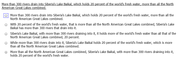
More than 300 rivers drain into Siberia's Lake Baikal, which holds 20 percent of the world's fresh water, more than all the North American Great Lakes combined.
A. More than 300 rivers drain into Siberia's Lake Baikal, which holds 20 percent of the world's fresh water, more than all the North American Great Lakes combined.
B. With 20 percent of the world's fresh water, that is more than all the North American Great Lakes combined, More than all the North American Great Lakes combined, Siberia's Lake Baikal
C. Siberia's Lake Baikal, with more than 300 rivers draining into it, it holds more of the world's fresh water than all that of the North American Great Lakes combined, 20 percent.
D. While more than 300 rivers drain into it, Siberia's Lake Baikal holds 20 percent of the world's fresh water, which is more than all the North American Great Lakes combined.
E. More than all the North American Great Lakes combined, Siberia's Lake Baikal, with more than 300 rivers draining into it, holds 20 percent of the world's fresh water.
In B,
that lacks a clear antecedent.
If
that is standing in for
20% of the world's fresh water, we get:
With 20% of the world's fresh water, 20% of the world's fresh water is more than all the North American Great Lakes combined.
This meaning is nonsensical.
Eliminate B.
In C,
holds serves as the verb for
it.
Thus,
Siberia's Lake Baikal (subject) lacks a verb.
Eliminate C.
On the GMAT,
which + singular verb must refer to the nearest preceding singular noun.
In D,
which seems to refer to
the world's fresh water, implying that the WORLD'S FRESH WATER
is
more than all the North American Great Lakes combined.
Not the intended meaning.
Eliminate D.
E implies that
Siberia's Lake Baikal is
more than all the North American Great Lakes combined.
This meaning is nonsensical: a lake cannot be MORE than another lake.
Eliminate E.
The correct answer is
A.
B:
Siberia's Lake Baikal has more than 300 rivers.
A
lake is a
body of water.
A body of water does not HAVE rivers.
Another reason to eliminate B.
Private tutor exclusively for the GMAT and GRE, with over 20 years of experience.
Followed here and elsewhere by over 1900 test-takers.
I have worked with students based in the US, Australia, Taiwan, China, Tajikistan, Kuwait, Saudi Arabia -- a long list of countries.
My students have been admitted to HBS, CBS, Tuck, Yale, Stern, Fuqua -- a long list of top programs.
As a tutor, I don't simply teach you how I would approach problems.
I unlock the best way for YOU to solve problems.
For more information, please email me (Mitch Hunt) at
[email protected].
Student Review #1
Student Review #2
Student Review #3