-
Aman verma
- Master | Next Rank: 500 Posts
- Posts: 304
- Joined: Wed Jan 27, 2010 8:35 am
- Location: International Space Station
- Thanked: 11 times
- Followed by:3 members
Geometry
This topic has expert replies
Source: Beat The GMAT — Problem Solving |
- theCodeToGMAT
- Legendary Member
- Posts: 1556
- Joined: Tue Aug 14, 2012 11:18 pm
- Thanked: 448 times
- Followed by:34 members
- GMAT Score:650
Is the answer [spoiler]{D}[/spoiler]?
Last edited by theCodeToGMAT on Sat Nov 16, 2013 12:05 pm, edited 1 time in total.
R A H U L
-
Mathsbuddy
- Master | Next Rank: 500 Posts
- Posts: 447
- Joined: Fri Nov 08, 2013 7:25 am
- Thanked: 25 times
- Followed by:1 members
Area of triangle = base x perpendicular height/2
We are given the ratios of the heights and are asked for the corresponding ratios of the bases.
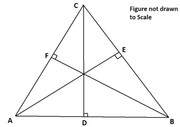
So, area * 2 = AB * CD = AC * BF = CB * AE
Substituting the given ratios gives:
2AB = 3AC = 4BC
So AC = 2AB/3 AND BC = AB/2
this means that AB:AC:BC = AB:2AB/3:AB/2
Multiplying by 6 and dividing by AB gives the simplified ratio of 6:4:3
Hence the answer is (D) 6:4:3
We are given the ratios of the heights and are asked for the corresponding ratios of the bases.
So, area * 2 = AB * CD = AC * BF = CB * AE
Substituting the given ratios gives:
2AB = 3AC = 4BC
So AC = 2AB/3 AND BC = AB/2
this means that AB:AC:BC = AB:2AB/3:AB/2
Multiplying by 6 and dividing by AB gives the simplified ratio of 6:4:3
Hence the answer is (D) 6:4:3
- GMATGuruNY
- GMAT Instructor
- Posts: 15539
- Joined: Tue May 25, 2010 12:04 pm
- Location: New York, NY
- Thanked: 13060 times
- Followed by:1906 members
- GMAT Score:790
Any side of a triangle can be deemed the base.
Each base has a corresponding height.
Definition of height: the perpendicular distance between the base and the opposite vertex.
Let CD=2, AE=3, and BF=4.
Let the area = the LCM of 2, 3, and 4 = 12.
If AB is deemed the base, the corresponding height is CD.
Since the area = 12, we get:
(1/2)(AB)(CD) = 12
(1/2)(AB)(2) = 12
AB = 12.
If BC is deemed the base, the corresponding height is AE.
Since the area = 12, we get:
(1/2)(BC)(AE) = 12
(1/2)(BC)(3) = 12
BC = 8.
If AC is deemed the base, the corresponding height is BF:
Since the area = 12, we get:
(1/2)(AC)(BF) = 12
(1/2)(AC)(4) = 12
AC = 6.
Resulting ratio:
AB:BC:AC = 12:8:6 = 6:4:3.
The correct answer is D.
Private tutor exclusively for the GMAT and GRE, with over 20 years of experience.
Followed here and elsewhere by over 1900 test-takers.
I have worked with students based in the US, Australia, Taiwan, China, Tajikistan, Kuwait, Saudi Arabia -- a long list of countries.
My students have been admitted to HBS, CBS, Tuck, Yale, Stern, Fuqua -- a long list of top programs.
As a tutor, I don't simply teach you how I would approach problems.
I unlock the best way for YOU to solve problems.
For more information, please email me (Mitch Hunt) at [email protected].
Student Review #1
Student Review #2
Student Review #3
Followed here and elsewhere by over 1900 test-takers.
I have worked with students based in the US, Australia, Taiwan, China, Tajikistan, Kuwait, Saudi Arabia -- a long list of countries.
My students have been admitted to HBS, CBS, Tuck, Yale, Stern, Fuqua -- a long list of top programs.
As a tutor, I don't simply teach you how I would approach problems.
I unlock the best way for YOU to solve problems.
For more information, please email me (Mitch Hunt) at [email protected].
Student Review #1
Student Review #2
Student Review #3




















