BREAKING: Target Test Prep releases Brand New 2026 On Demand GMAT prep course

Redeem

Target Test Prep · GMAT

Choose how you want to prepare

Learn live with an expert or move at your own pace. Every option includes the complete TTP study system.

★★★★★5.0559 reviews
GMATLiveTeach 7 seats left
Chris Peckover
NEXT LIVE COHORT

Oct 13 to Jan 7, 2027

with Chris Peckover

Schedule
Tue, Thu · 8:00 to 10:00 PM ET
Included
40 live hours + 6 months of GMAT OnDemand
  • Live instruction and real-time questions
  • Class recordings and assigned practice
View class & enroll
Limited cohort · enrollment openTarget Test Prep
EALiveTeach 5 seats left
Logan Thompson
EXECUTIVE ASSESSMENT

Sep 6 to Dec 6, 2026

with Logan Thompson

Schedule
Sun · 9:30 AM to 12:30 PM ET
Included
40 hours of live online classes plus six months of access to the complete TTP EA OnDemand course.
  • 165+ EA Score Guarantee
  • 4,100+ Quant, Verbal, and Integrated Reasoning practice questions
  • 400+ hours of in-depth video lessons
  • 3,000+ step-by-step video solutions
View EA class & enroll
Limited cohort · enrollment openTarget Test Prep
GMATOnDemand Start anytime
SELF-PACED MASTERCLASS

Target Test Prep GMAT OnDemand

Complete access from day one. Study on your schedule.

715+ score guarantee
$0to start then $127/mo
  • Personalized study plan and analytics
  • Thousands of lessons and practice questions

Compare the format, schedule, and included access before enrolling. Prices and seat counts shown reflect the supplied offer details.

Compound Interest

Expert replies
by datonman » Wed Feb 11, 2015 11:23 am
Is there a better way to answer this question?

Matt is planning to buy a car in three years. He wants to invest $5000 now and hopes to have $6000 to spend on the car when he buys it. What kind of interest rate would he need if his investment is compounded monthly?

A solution to this problem would be:

I used the formula like so: A=p(1+r/n)^nt

*6000=5000(1+r/12)^12 times 3
*6000=5000(1+r/12)^36
-divide sides by 5000

^1/36(1.2)=((1+r/12)^36)^1/36

1+r/12=1.00508
subtracting both sides by 1

r/12=0.00508
then multiply both sides by 12

r=approx 0.061 or 6.1%

is there a better way to solve this question?
Join the discussion
Source: — Problem Solving |

by Brent@GMATPrepNow » Wed Feb 11, 2015 11:31 am
datonman wrote:Is there a better way to answer this question?

Matt is planning to buy a car in three years. He wants to invest $5000 now and hopes to have $6000 to spend on the car when he buys it. What kind of interest rate would he need if his investment is compounded monthly?

A solution to this problem would be:

I used the formula like so: A=p(1+r/n)^nt

*6000=5000(1+r/12)^12 times 3
*6000=5000(1+r/12)^36
-divide sides by 5000

^1/36(1.2)=((1+r/12)^36)^1/36
Should be: (1.2)^(1/36)=((1+r/12)^36)^1/36


1+r/12=1.00508
subtracting both sides by 1

r/12=0.00508
then multiply both sides by 12

r=approx 0.061 or 6.1%

is there a better way to solve this question?
What's the source of this question?

What are the answer choices?
You've set things up correctly, but the GMAT would never require you to evaluate (1.2)^(1/36)

Cheers,
Brent
Brent Hanneson - Creator of GMATPrepNow.com
Image
Join the discussion

by [email protected] » Wed Feb 11, 2015 12:00 pm
Hi datonman,

Brent is correct - the GMAT would never ask you to calculate this complex of a result. The question would also include the answer choices, so you could use them to your advantage and likely avoid the big calculation entirely.

GMAT assassins aren't born, they're made,
Rich
Contact Rich at [email protected]
Image
Join the discussion

by DavidG@VeritasPrep » Sun Feb 15, 2015 3:25 am
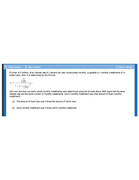
Often, compound interest questions on the GMAT are less about calculations than they are about a conceptual understanding. See the attached data sufficiency question, which, at first glance, looks significantly more harrowing than it is
Image
Veritas Prep | GMAT Instructor

Veritas Prep Reviews
Save $100 off any live Veritas Prep GMAT Course
Join the discussion