BREAKING: Target Test Prep releases Brand New 2026 On Demand GMAT prep course

Redeem

Target Test Prep · GMAT

Choose how you want to prepare

Learn live with an expert or move at your own pace. Every option includes the complete TTP study system.

★★★★★5.0559 reviews
GMATLiveTeach 7 seats left
Chris Peckover
NEXT LIVE COHORT

Oct 13 to Jan 7, 2027

with Chris Peckover

Schedule
Tue, Thu · 8:00 to 10:00 PM ET
Included
40 live hours + 6 months of GMAT OnDemand
  • Live instruction and real-time questions
  • Class recordings and assigned practice
View class & enroll
Limited cohort · enrollment openTarget Test Prep
EALiveTeach 5 seats left
Logan Thompson
EXECUTIVE ASSESSMENT

Sep 6 to Dec 6, 2026

with Logan Thompson

Schedule
Sun · 9:30 AM to 12:30 PM ET
Included
40 hours of live online classes plus six months of access to the complete TTP EA OnDemand course.
  • 165+ EA Score Guarantee
  • 4,100+ Quant, Verbal, and Integrated Reasoning practice questions
  • 400+ hours of in-depth video lessons
  • 3,000+ step-by-step video solutions
View EA class & enroll
Limited cohort · enrollment openTarget Test Prep
GMATOnDemand Start anytime
SELF-PACED MASTERCLASS

Target Test Prep GMAT OnDemand

Complete access from day one. Study on your schedule.

715+ score guarantee
$0to start then $127/mo
  • Personalized study plan and analytics
  • Thousands of lessons and practice questions

Compare the format, schedule, and included access before enrolling. Prices and seat counts shown reflect the supplied offer details.

Tough Geometry Question

Expert replies
by Mo2men » Thu Jul 27, 2017 6:59 am
In triangle ABC, if angle ABC is 30 degrees, AC = 2 * √2 and AB = BC = X, what is the value of X?

A) √3 - 1

B) √3 + 2

C) (√3 - 1) / 2

D) (√3 + 1) / 2

E) 2 * (√3 + 1)

OA: E
Source: Veritas
Join the discussion
Source: — Problem Solving |

by [email protected] » Thu Jul 27, 2017 12:13 pm
Hi Mo2men,

The answer choices to this question are designed in such a way that you can use a bit of logical estimation and eliminate all of the wrong answers.

Based on the description in the prompt, we're dealing with an ISOSCELES triangle (30/75/75) and the 'short side' is 2√2. While you might not immediately know the value of √2, you probably know that 14^2 = 196, so (1.4)^2 = 1.96... thus, you can reasonably estimate √2 = 1.4

Thus, 2√2 is approximately 2.8). By definition, the two longer sides would be considerably BIGGER than 2.8 (not necessarily double, but the ratio of the angles- 75 to 30 - means that X would NOT be close to 2.8), so we can now estimate if any of the answers would be too small relative to what X should probably be.

√3 is clearly less than √4 - so √3 is clearly LESS than 2. Using the same math that you used to determine the approximate value of √2, you can determine that √3 is about 1.7

Answer A: (1.7) - 1 = (0.7). NOT a match.
Answer B: (1.7) + 2 = (3.7). Maybe... but this answer is relatively close to 2.8.....
Answer C: (0.7)/2 = (0.35). NOT a match.
Answer D: (2.7)/2 = (1.35). NOT a match.
Answer E: 2(2.7) = (5.4)

Given the ratio of angles, Answer E makes a lot more 'sense' from a mathematical standpoint than Answer B does.

Final Answer: E

GMAT assassins aren't born, they're made,
Rich
Contact Rich at [email protected]
Image
Join the discussion

by GMATGuruNY » Thu Jul 27, 2017 4:23 pm
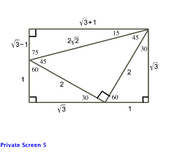
The following figure is known as the Ailles rectangle:
Image
The figure above illustrates the following:
In a 15-75-90 triangle, (shorter leg)/(hypotenuse) = (√3 - 1)/(2√2).
Mo2men wrote:In triangle ABC, if angle ABC is 30 degrees, AC = 2 * √2 and AB = BC = X, what is the value of X?

A) √3 - 1

B) √3 + 2

C) (√3 - 1) / 2

D) (√3 + 1) / 2

E) 2 * (√3 + 1)
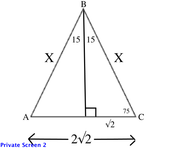
If we split the given triangle in half, the following figure is yielded:
Image

In the 15-75-90 triangle on the right, the shorter leg = √2 and the hypotenuse = X.
Since (shorter leg)/(hypotenuse) = (√3 - 1)/(2√2), we get:
(√2)/X = (√3 - 1)/(2√2)

X(√3 - 1) = (√2)(2√2)

X(√3 - 1) = 4

X = 4/(√3 - 1)

X = [4(√3 + 1)] / [(√3 - 1)(√3 + 1)]

X = [4(√3 + 1)] / (3 - 1)

X = [4(√3 + 1)] / 2

X = 2(√3 + 1).

The correct answer is E.
Private tutor exclusively for the GMAT and GRE, with over 20 years of experience.
Followed here and elsewhere by over 1900 test-takers.
I have worked with students based in the US, Australia, Taiwan, China, Tajikistan, Kuwait, Saudi Arabia -- a long list of countries.
My students have been admitted to HBS, CBS, Tuck, Yale, Stern, Fuqua -- a long list of top programs.

As a tutor, I don't simply teach you how I would approach problems.
I unlock the best way for YOU to solve problems.

For more information, please email me (Mitch Hunt) at [email protected].
Student Review #1
Student Review #2
Student Review #3
Join the discussion

by Matt@VeritasPrep » Mon Aug 07, 2017 12:02 am
Not that I'm against the Ailles rectangle, but I don't think we should assume students would know that or dream it up.

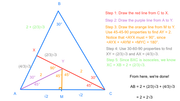
How about this, a very GMAT appropriate way that only requires drawing a few lines and knowing the ratios of 45-45-90 and 30-60-90s. No algebra is used here, and the steps are color coded to the diagram, so you can see what is added at each step:

Image
Join the discussion

by Matt@VeritasPrep » Mon Aug 07, 2017 12:05 am
Two important takeaways from my approach:

1) Drawing a well-chosen line can make seemingly impossible geometry questions very accessible, so when in doubt, ask yourself if you can draw something;

2) Always remind yourself that a GMAT problem can't rely on anything beyond the basics you were taught. You aren't expected to know what to do with a 75° angle - this isn't trigonometry - but if you realize that 75° = 30° + 45°, all of a sudden you can use some very friendly and familiar triangles that you WERE taught.
Join the discussion