BREAKING: Target Test Prep releases Brand New 2026 On Demand GMAT prep course

Redeem

Target Test Prep · GMAT

Choose how you want to prepare

Learn live with an expert or move at your own pace. Every option includes the complete TTP study system.

★★★★★5.0559 reviews
Vote for Target Test Prep, Newsweek Readers’ Choice Awards 2026
NEWSWEEK READERS’ CHOICE 2026

BIG NEWS! Target Test Prep has been nominated, and they’d love your vote!

TTP has worked incredibly hard to build the best test prep experience possible, and winning Newsweek’s 2026 Readers’ Choice Award for Best Test Prep would mean a lot to them. If TTP has helped you, they’d be incredibly grateful for your vote. You can vote once each day through September 9.

Vote for TTP
GMATLiveTeach 7 seats left
Chris Peckover
NEXT LIVE COHORT

Oct 13 to Jan 7, 2027

with Chris Peckover

Schedule
Tue, Thu · 8:00 to 10:00 PM ET
Included
40 live hours + 6 months of GMAT OnDemand
  • Live instruction and real-time questions
  • Class recordings and assigned practice
View class & enroll
Limited cohort · enrollment openTarget Test Prep
EALiveTeach 5 seats left
Logan Thompson
EXECUTIVE ASSESSMENT

Sep 6 to Dec 6, 2026

with Logan Thompson

Schedule
Sun · 9:30 AM to 12:30 PM ET
Included
40 hours of live online classes plus six months of access to the complete TTP EA OnDemand course.
  • 165+ EA Score Guarantee
  • 4,100+ Quant, Verbal, and Integrated Reasoning practice questions
  • 400+ hours of in-depth video lessons
  • 3,000+ step-by-step video solutions
View EA class & enroll
Limited cohort · enrollment openTarget Test Prep
GMATOnDemand Start anytime
SELF-PACED MASTERCLASS

Target Test Prep GMAT OnDemand

Complete access from day one. Study on your schedule.

715+ score guarantee
$0to start then $127/mo
  • Personalized study plan and analytics
  • Thousands of lessons and practice questions

Compare the format, schedule, and included access before enrolling. Prices and seat counts shown reflect the supplied offer details.

Help requested

Expert replies
Source: — Problem Solving |

by Anurag@Gurome » Sun Oct 07, 2012 10:44 pm
Explanation to Q1:

Let the actual ratio be 3N : 4N
When both the numerator and denominator are increased by 5, then ratio becomes (3N + 5) : (4N + 5)
Until we know the value of N, we can not determine the actual ratio.

The correct answer is E.
Anurag Mairal, Ph.D., MBA
GMAT Expert, Admissions and Career Guidance
Gurome, Inc.
1-800-566-4043 (USA)

Join Our Facebook Groups
GMAT with Gurome
https://www.facebook.com/groups/272466352793633/
Admissions with Gurome
https://www.facebook.com/groups/461459690536574/
Career Advising with Gurome
https://www.facebook.com/groups/360435787349781/
Join the discussion

by Anurag@Gurome » Sun Oct 07, 2012 11:00 pm
Explanation to Q2:

2x - 3y ≤ -6 implies y ≥ (2x/3) + 2
Let us draw the above line in the coordinate system. Let us write the line in the form, x/A + y/B = 1.
So, the line is x/(-3) + y/2 = 1

Image

It can be seen that the mentioned area is above quadrant IV and does not contain any point of this quadrant.

The correct answer is E.
Anurag Mairal, Ph.D., MBA
GMAT Expert, Admissions and Career Guidance
Gurome, Inc.
1-800-566-4043 (USA)

Join Our Facebook Groups
GMAT with Gurome
https://www.facebook.com/groups/272466352793633/
Admissions with Gurome
https://www.facebook.com/groups/461459690536574/
Career Advising with Gurome
https://www.facebook.com/groups/360435787349781/
Join the discussion

by btthus » Sun Oct 07, 2012 11:18 pm
Thank you for the quick response...
Would the ≥ v.s. =, change the answer? What is the reasoning for using ≥ instead of =?
Anurag@Gurome wrote:Explanation to Q2:

2x - 3y ≤ -6 implies y ≥ (2x/3) + 2
Let us draw the above line in the coordinate system. Let us write the line in the form, x/A + y/B = 1.
So, the line is x/(-3) + y/2 = 1

Image

It can be seen that the mentioned area is above quadrant IV and does not contain any point of this quadrant.

The correct answer is E.
Thanks for the quick response...
Does the ≤ symbol make a difference
Anurag@Gurome wrote:Explanation to Q2:

2x - 3y ≤ -6 implies y ≥ (2x/3) + 2
Let us draw the above line in the coordinate system. Let us write the line in the form, x/A + y/B = 1.
So, the line is x/(-3) + y/2 = 1

Image

It can be seen that the mentioned area is above quadrant IV and does not contain any point of this quadrant.

The correct answer is E.
Join the discussion

by Whitney Garner » Mon Oct 08, 2012 6:43 am
btthus wrote:Thank you for the quick response...
Would the ≥ v.s. =, change the answer? What is the reasoning for using ≥ instead of =?
Hi btthus!

The presence of the ≥ is essential and so let's make sure that we clearly explain it! The question is asking for the empty quadrant if we graph the inequality 2x - 3y ≤ -6. See, this isn't just a line, this is actually the expression for an AREA or REGION of the graph. That is the difference between the ≤ and the = sign: an = would be just the line, the inclusion of the < or > will determine which side of the line we would shade (and I'll explain how simply knowing that the line doesn't pass through quadrant 4 is NOT enough to say that quad 4 would be empty!!) So let's practice graphing inequalities!

Step 1: Get the Inequality in Slope-Intercept Form (y=mx+b)
You can certainly graph lines in several ways, but the easiest way to graph an inequality is to put it in y=mx+b form.

y = mx + b (where M is the slope and B is the Y-intercept = solve the inequality for Y).

2x - 3y ≤ -6
-3y ≤ -2x - 6
y ≥ (2/3)x + 2 ...(flip the sign due to division by negative)

Step 2: Graph this as a LINE (equality)
Noe we want to ignore the ≥ symbol and just make it an = sign.

y = (2/3)x + 2

This means we have the y-intercept at +2, and the slope is +(2/3). Since we don't really care about specific points on this graph, we just need to have a line that hits the Y-axis above the origin and is upward sloping (I graphed this with the accurate intercepts but you DO NOT need to here - just get a general location on the grid):
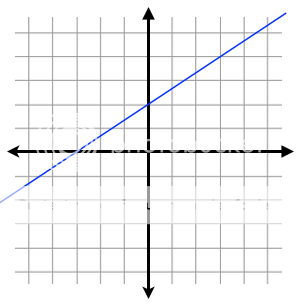
Image

Step 3: Shade in the Inequality Region
Once we are in y=mx+b form this is actually VERY easy. Because our actual inequality is y ≥ (2/3)x + 2, we shade the area on the side of the line where Y is larger than the line (so shade the area where Y-axis values are higher - that means ABOVE the line. And that is IT - you're done!!
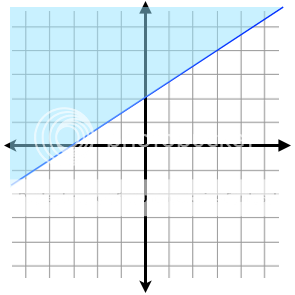
Image

Now we can see that the empty quadrant is Quadrant IV. But what would have happened if when we solved for the inequality we ended up with y ≤ (2/3)x + 2? If you guessed that we would have shaded the area BELOW the line, you would be exactly right!! And that would mean that there were NO empty quadrants! So we can see how important the presence of the ≤ or ≥ actually is!!

Hope this helps!
:)
Whit
Whitney Garner
GMAT/GRE/EA Instructor & Anxiety/Accommodations Coach
www.whitneygarner.com

Contributor to Beat The GMAT!

Math is a lot like love - a simple idea that can easily get complicated :heart-eyes:
Join the discussion

by btthus » Mon Oct 08, 2012 1:57 pm
Your a legend. Thank you Whitney.
Whitney Garner wrote:
btthus wrote:Thank you for the quick response...
Would the ≥ v.s. =, change the answer? What is the reasoning for using ≥ instead of =?
Hi btthus!

The presence of the ≥ is essential and so let's make sure that we clearly explain it! The question is asking for the empty quadrant if we graph the inequality 2x - 3y ≤ -6. See, this isn't just a line, this is actually the expression for an AREA or REGION of the graph. That is the difference between the ≤ and the = sign: an = would be just the line, the inclusion of the < or > will determine which side of the line we would shade (and I'll explain how simply knowing that the line doesn't pass through quadrant 4 is NOT enough to say that quad 4 would be empty!!) So let's practice graphing inequalities!

Step 1: Get the Inequality in Slope-Intercept Form (y=mx+b)
You can certainly graph lines in several ways, but the easiest way to graph an inequality is to put it in y=mx+b form.

y = mx + b (where M is the slope and B is the Y-intercept = solve the inequality for Y).

2x - 3y ≤ -6
-3y ≤ -2x - 6
y ≥ (2/3)x + 2 ...(flip the sign due to division by negative)

Step 2: Graph this as a LINE (equality)
Noe we want to ignore the ≥ symbol and just make it an = sign.

y = (2/3)x + 2

This means we have the y-intercept at +2, and the slope is +(2/3). Since we don't really care about specific points on this graph, we just need to have a line that hits the Y-axis above the origin and is upward sloping (I graphed this with the accurate intercepts but you DO NOT need to here - just get a general location on the grid):

Image

Step 3: Shade in the Inequality Region
Once we are in y=mx+b form this is actually VERY easy. Because our actual inequality is y ≥ (2/3)x + 2, we shade the area on the side of the line where Y is larger than the line (so shade the area where Y-axis values are higher - that means ABOVE the line. And that is IT - you're done!!

Image

Now we can see that the empty quadrant is Quadrant IV. But what would have happened if when we solved for the inequality we ended up with y ≤ (2/3)x + 2? If you guessed that we would have shaded the area BELOW the line, you would be exactly right!! And that would mean that there were NO empty quadrants! So we can see how important the presence of the ≤ or ≥ actually is!!

Hope this helps!
:)
Whit
Join the discussion



















