BREAKING: Target Test Prep releases Brand New 2026 On Demand GMAT prep course

Redeem

Target Test Prep · GMAT

Choose how you want to prepare

Learn live with an expert or move at your own pace. Every option includes the complete TTP study system.

★★★★★5.0559 reviews
GMATLiveTeach 7 seats left
Chris Peckover
NEXT LIVE COHORT

Oct 13 to Jan 7, 2027

with Chris Peckover

Schedule
Tue, Thu · 8:00 to 10:00 PM ET
Included
40 live hours + 6 months of GMAT OnDemand
  • Live instruction and real-time questions
  • Class recordings and assigned practice
View class & enroll
Limited cohort · enrollment openTarget Test Prep
EALiveTeach 5 seats left
Logan Thompson
EXECUTIVE ASSESSMENT

Sep 6 to Dec 6, 2026

with Logan Thompson

Schedule
Sun · 9:30 AM to 12:30 PM ET
Included
40 hours of live online classes plus six months of access to the complete TTP EA OnDemand course.
  • 165+ EA Score Guarantee
  • 4,100+ Quant, Verbal, and Integrated Reasoning practice questions
  • 400+ hours of in-depth video lessons
  • 3,000+ step-by-step video solutions
View EA class & enroll
Limited cohort · enrollment openTarget Test Prep
GMATOnDemand Start anytime
SELF-PACED MASTERCLASS

Target Test Prep GMAT OnDemand

Complete access from day one. Study on your schedule.

715+ score guarantee
$0to start then $127/mo
  • Personalized study plan and analytics
  • Thousands of lessons and practice questions

Compare the format, schedule, and included access before enrolling. Prices and seat counts shown reflect the supplied offer details.

Help me solve this GMAT Quant Question (GMATPrep)

Problem Solving — algebra and arithmetic (GMAT Focus Edition)
Expert replies
by EricImasogie » Fri Dec 12, 2014 5:29 am
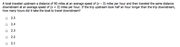
I have attached the question as an image. I started off by setting both the downstream and upstream equations to each other since they both have the same 'd' (distance) ( d = s * t ) .
Image
Join the discussion
Source: — Quantitative Reasoning |

by MartyMurray » Fri Dec 12, 2014 6:40 am
EricImasogie wrote:I have attached the question as an image. I started off by setting both the downstream and upstream equations to each other since they both have the same 'd' (distance) ( d = s * t ) .

Image
Let's try that way.

We start with rate(r) * time(t) = distance(d), and get two equations.

(v - 3)(t + 1/2) = 90 and (v + 3)(t) = 90

Now we can set them equal to each other, because they both equal 90.

(v - 3)(t + 1/2) = (v + 3)(t)

Multiply it all out.

vt + v/2 - 3t - 3/2 = vt + 3t

Simplify.

v/2 - 3/2 = 6t

v - 3 = 12t

Now we can substitute the 12t for (v - 3) in the upstream equation and solve for t.

(12t)(t + 1/2) = 90 12t^2 + 6t = 90 2t^2 + t = 15 2t^2 + t - 15 = 0 (2t - 5)(t + 3) = 0

t = -3 or 2.5. Throw out the - 3, at least in this universe. Choose A.

That's a fair amount of work. Wondering if there is a better way.
Join the discussion

by Brent@GMATPrepNow » Fri Dec 12, 2014 6:40 am
A boat travelled upstream a distance of 90 miles at an average speed of (v-3) miles per hour and then travelled downstream at an average speed of (V+3) miles per hour. If the trip upstream took half an hour longer than the trip downstream, how many hours did it take the boat to travel downstream?
A) 2.5
B) 2.4
C) 2.3
D) 2.2
E) 2.1
I like to begin with a "word equation." We can write:
travel time upstream = travel time downstream + 1/2

Time = distance/rate
So, we can replace elements in our word equation to get:
90/(v-3) = 90/(v+3) + 1/2

Now solve for v (lots of work here)
.
.
.
v = 33

So, travel time downstream = 90/(v+3)
= 90/(33+3)
= 90/36
= 5/2
= 2 1/2 hours

Answer: A

Cheers,
Brent
Brent Hanneson - Creator of GMATPrepNow.com
Image
Join the discussion

by MartyMurray » Fri Dec 12, 2014 8:42 am
For the record, I thought maybe I had found a simpler way, and the new way still took about the same amount of work and came down to the same quadratic equation to factor.
Join the discussion

by [email protected] » Fri Dec 12, 2014 11:04 am
Hi EricImasogie,

This question can be solved by TESTing THE ANSWERS, but you still have to take lots of notes and stay organized.

First, we have 2 equations that we need to write down (they both involved the Distance Formula and the given 90 mile distance):

Upstream:
90 = (V-3)(T + 1/2)

Downstream:
90 = (V+3)(T)

Since we're multiplying two different sets of values and the product is 90 in both equations, it's highly unlikely that we'll be dealing with a "weird" decimal - we need to end up with round numbers, so the value that I would TEST first is 2.5

If T = 2.5...

Upstream:
90 = (V-3)(3)
90 = 3V - 9
99 = 3V
33 = V

Downstream:
90 = (V+3)(2.5)
90 = 2.5V + 7.5
82.5 = 2.5V
165 = 5V
33 = V

Since BOTH V's have the same value, this MUST be the solution.

Final Answer: A

GMAT assassins aren't born, they're made,
Rich
Contact Rich at [email protected]
Image
Join the discussion

by EricImasogie » Fri Dec 12, 2014 11:35 am
wow thanks guys! its amazing how one needs varying perspectives just to get through some of these problems. I have been so used to doing these s=d/t problems a certain way that I get sidelined when the GMAT throws a problem requiring a different outlook that requires a creative mode of thinking. geesh! thanks guys!
Join the discussion

by [email protected] » Fri Dec 12, 2014 6:52 pm
Hi EricImasogie,

As you continue to study, you're going to find that most GMAT questions can be approached in a variety of ways (they're actually designed that way). Since the Quant section of the GMAT is NOT (strictly speaking) a "math test", you'll benefit greatly by learning other ways of approaching questions beyond "just doing math." You should absolutely continue to post questions in these Forums - you'll learn a lot from everyone here.

GMAT assassins aren't born, they're made,
Rich
Contact Rich at [email protected]
Image
Join the discussion



















