nandy1984 wrote:Beginning in January of last year, Carl made deposits of $120 into his account on the 15th of each month for several consecutive months and then made withdrawals of $50 from the account on the 15th of each of the remaining months of last year. There were no other transactions in the account last year. If the closing balance of Carl's account for May of last year was $2,600, what was the range of the monthly closing balances of Carl's account last year?
(1) Last year the closing balance of Carl's account for April was less than $2,625.
(2) Last year the closing balance of Carl's account for June was less than $2,675.
Can you help me solving this...Please do explain the approach as solution can be achieved but we have the time constraint so please do explain how it can be done with in 2mins...Some takeaways...THANKS...
I would definitely start with a quick rephrase based on what we know in the question and what information is coming in the statements. We want the range of closing balances and are only given one. BUT, we know that at some point during the year, Carl moved from depositing $120 to withdrawing $50. If we knew the exact month that happened, we could do all of the calculations off of the May balance, find the highest and the lowest and then subtract. So, we just need to know when Carl switched from saving to spending.
We know that in May, the Closing balance was $2600. When we glance at the statements, we see that we are given ranges for the April and June balances, so let's set up a comparison for these 3 months.
Time Taken to Read & Understand what the heck is going on: 45 seconds to 1 minute.
We know that to obtain $2600 for the May balance, Carl had to either add $120 to his April Balance or subtract $50 from it. We also know that to get to his June balance, Carl either had to add $120 to the $2600 from May or subtract $50 from it.
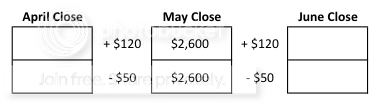
Now, to get to the potential values for June, just add or subtract:
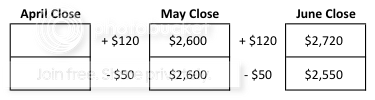
And to back solve to April, we just have to think - if he ADDED $120 to the April balance and ended up with $2600, he had to start with $2600-$120 = $2480. If he Subtracted $50 from the April balance and ended up with $2600, he had to start with $2600+$50 = $2650.
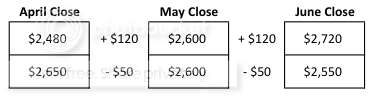 Time Taken to Calculate and Fill out Info: 30 seconds.
Now we are ready to analyze the statements:
(1) This says that April's balance was less than $2625, so it must have been $2480, meaning that Carl was still depositing $120 in May. But we don't know when he stopped depositing, just that it was sometime after May.
Insufficient
(2) This says that June's balance was less than $2675, so it must have been $2550, meaning that Carl spend $50 in June. But, we don't know when he started spending, only that it was at least as early as June, but could have been earlier.
Insufficient
(1+2) We know that Carl was still saving in May, but then spent in June. We were told in the question that once he moved from saving $120, he started spending $50 and never went back. This means that for the months Jan-May he saved and from Jun-Dec he spent. We know when the switch occurred so we could solve for the values for every month and get a range.
Sufficient
Time Taken to analyze the Statements: 30 seconds.
The answer is C, in 2 minutes or less.






















