BREAKING: Target Test Prep releases Brand New 2026 On Demand GMAT prep course

Redeem

Target Test Prep · GMAT

Choose how you want to prepare

Learn live with an expert or move at your own pace. Every option includes the complete TTP study system.

★★★★★5.0559 reviews
GMATLiveTeach 7 seats left
Chris Peckover
NEXT LIVE COHORT

Oct 13 to Jan 7, 2027

with Chris Peckover

Schedule
Tue, Thu · 8:00 to 10:00 PM ET
Included
40 live hours + 6 months of GMAT OnDemand
  • Live instruction and real-time questions
  • Class recordings and assigned practice
View class & enroll
Limited cohort · enrollment openTarget Test Prep
EALiveTeach 5 seats left
Logan Thompson
EXECUTIVE ASSESSMENT

Sep 6 to Dec 6, 2026

with Logan Thompson

Schedule
Sun · 9:30 AM to 12:30 PM ET
Included
40 hours of live online classes plus six months of access to the complete TTP EA OnDemand course.
  • 165+ EA Score Guarantee
  • 4,100+ Quant, Verbal, and Integrated Reasoning practice questions
  • 400+ hours of in-depth video lessons
  • 3,000+ step-by-step video solutions
View EA class & enroll
Limited cohort · enrollment openTarget Test Prep
GMATOnDemand Start anytime
SELF-PACED MASTERCLASS

Target Test Prep GMAT OnDemand

Complete access from day one. Study on your schedule.

715+ score guarantee
$0to start then $127/mo
  • Personalized study plan and analytics
  • Thousands of lessons and practice questions

Compare the format, schedule, and included access before enrolling. Prices and seat counts shown reflect the supplied offer details.

Cirlce chord Question

Expert replies
Source: — Problem Solving |

by ganeshrkamath » Thu Aug 29, 2013 11:27 am
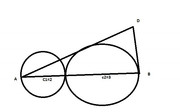
akhilpahuja wrote:Two circle C1 and C2 of radius 2 and 3 respectively touch each other as shown in the figure. If AD and BD are tangents the the length of BD is
a) 3(6)^1/2 b) 5(6)^1/2
c) 7(6)^1/2 d) 6
e) 5(3)^1/2


Image
I think there's a typo in the question. Circle with center C1 will have radius 1.

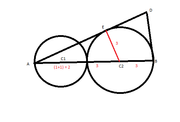
Image

Draw EC2 perpendicular to AD.
Angle AEC2 = 90 degrees
So from pythagoras theorem: AE^2 = AC2^2 - EC2^2
AE^2 = 5^2 - 3^2 = 16
AE = 4

Since BD is also a tangent, angle ABD = 90 degrees.
ED = BD (triangles C2ED and C2BD are congruent)
Applying pythagoras theorem to triangle ABD:
AD^2 = AB^2 + BD^2
(AE + ED)^2 = 8^2 + BD^2
16 + ED^2 + 8ED = 64 + BD^2
16 + BD^2 + 8BD = 64 + BD^2
8BD = 48
BD = 6

Choose [spoiler](d)[/spoiler]

Cheers
Every job is a self-portrait of the person who did it. Autograph your work with excellence.

Kelley School of Business (Class of 2016)
GMAT Score: 750 V40 Q51 AWA 5 IR 8
https://www.beatthegmat.com/first-attemp ... tml#688494
Join the discussion

by Mike@Magoosh » Tue Sep 03, 2013 8:56 am
akhilpahuja wrote:Two circle C1 and C2 of radius 2 and 3 respectively touch each other as shown in the figure. If AD and BD are tangents the the length of BD is
(A) 3(6)^1/2
(B) 5(6)^1/2
(C) 7(6)^1/2
(D) 6
(E) 5(3)^1/2
Dear Akhilpahuja,
I'm happy to help with this.

Here are a couple blogs in which I discuss related material:
https://magoosh.com/gmat/2012/circle-and ... -the-gmat/
https://magoosh.com/gmat/2012/inscribed- ... -the-gmat/

I agree with ganeshrkamath --- as the question is stated, the correct answer is not here. Here is a solution of the question, as stated. Refer to the diagram, which is drawn to scale.

We construct (C2)E, which forms a right angle, because a radius is always perpendicular to a tangent at the point of tangency. We know (C2)E = 3, because it's a radius of a circle. A(C2) = 7, and we can find AE by the Pythagorean Theorem.

(AE)^2 + 3^2 = 7^2
(AE)^2 + 9 = 49
(AE)^2 = 40
AE = sqrt(40) = 2*sqrt(10)

Now, we take advantage of the proportionality between the similar triangles. Triangle AE(C2) is proportional to triangle ADB, in that order of proportionality. The angles at A are the same, and the right angles are congruent (this is a rule in Geometry known as AA Similarity). The sides of similar triangles are proportional, so we can set up a proportion:

(BD)/(AD) = [(C2)E]/AE
BD/10 = 3/(2*sqrt(10))
BD = (3/2)*10/sqrt(10) = (3/2)*sqrt(10)

That length for BD is not listed.

I will say, this problem, as it current stands, is a bit difficult for a GMAT problem. This would really be at the outer edge of what the GMAT would expect you to know.

Meanwhile, I thought ganeshrkamath suggested a brilliant simple edit --- just changing the radius of the first circle from 2 to 1 (alternately, changing radius = 2 to diameter = 2), makes the problem extraordinarily elegant, much like a real GMAT problem. I don't know if what the source is, but I would surprised if ganeshrkamath is not correct.

I hope this helps.
Mike :-)
Attachments
triangle with tangent lines.JPG
Magoosh GMAT Instructor
https://gmat.magoosh.com/
Join the discussion