
BREAKING: Target Test Prep releases Brand New 2026 On Demand GMAT prep course

Redeem

DS-5

Expert replies
by candygal79 » Fri Apr 04, 2014 12:50 am
This morning, a certain sugar container was full. Since then some of the sugar from this container was used to make cookies. If no other sugar was removed from or added to the container, by what percent did the amount of sugar in the container decrease ?

1) The amount of sugar in the container after making the cookies would need to be increased by 30 percent to fill the container

2) Six cups of sugar from the container were used to make the cookies
Join the discussion
Source: — Data Sufficiency |

by tathastuGMAT » Mon Apr 28, 2014 12:30 am
Please refer the attachment for solution.

-tathastuGMAT
Image
People don't fail, they just give up. Never give up!

www.tathastugmat.com
Join the discussion

by ceilidh.erickson » Wed Apr 30, 2014 9:26 am
If a DS question asks us for a proportional change, we often don't need real values to answer the question - we just need another proportion to compare it to.

Question: by what percent did the amount of sugar in the container decrease?
Rephrase: we need to be able to compare the proportions before and after the change.

1) The amount of sugar in the container after making the cookies would need to be increased by 30 percent to fill the container
If we know that the original amount is 30% greater than the new amount, we have a proportional comparison between the amounts. We could set this up algebraically:
original = (1.3)(new)
new = (10/13)(original)
To calculate the actual percent change, we'd need to turn 3/13 into a decimal, which would be messy. But since this is DS, we don't have to do the math! If we know the original as a percentage of the new, we know that we could figure out the new as a percentage of the original. Don't do the math to prove it.
Sufficient.

2) Six cups of sugar from the container were used to make the cookies
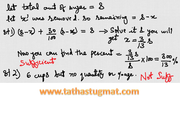
This gives us a value, but no proportions. We don't know how big a proportion this is of the original amount. Insufficient.

The answer is A.
Ceilidh Erickson
EdM in Mind, Brain, and Education
Harvard Graduate School of Education
Join the discussion

















