Approach:
Statement 1:
ab=50
The Inflection point a= 7, b=50/7..Here also (a+b) > 14
In all other cases, (a+b) is greater than 14...
SO SUFFICIENT
Statement 2:
c=10
Case I: a=6 ,b=8 implies a+b=14 so perimeter is 2*(a+b)=28
Case II : a=5*sqrt(3), b=5 a+b=5*(1+sqrt(3)) <14..so perimeter <28
Two different answer
INSUFFICIENT
So (A) is the answer
rectangle R greater
-
ArunangsuSahu
- Master | Next Rank: 500 Posts
- Posts: 382
- Joined: Thu Mar 31, 2011 5:47 pm
- Thanked: 15 times
Hi,
Can you please guide me why my below explanation is false..
(a+b)^2 = a^2+b^2+2ab
= 10^2 + 2x50
= 100+100
= 200
Therefore = (a+b) = 10sqrt(2)
so perimeter 2(a+b) = 20 x sqrt(2) > 28
So both Statement together help to find the solution.
Can you please guide me why my below explanation is false..
(a+b)^2 = a^2+b^2+2ab
= 10^2 + 2x50
= 100+100
= 200
Therefore = (a+b) = 10sqrt(2)
so perimeter 2(a+b) = 20 x sqrt(2) > 28
So both Statement together help to find the solution.
GMATGuruNY wrote:Statement 1:sanju09 wrote:Is the perimeter of rectangle R greater than 28?
(1) Area of rectangle R is 50.
(2) Diagonal of rectangle R is 10.
LW = 50.
Let's assume that the perimeter = 28.
Then 2(L+W) = 28, L+W=14, and W=14-L.
Substituting into LW=50, we get:
L(14-L) = 50.
14L - L^2 -50 = 0.
L^2 - 14L + 50 = 0.
For any quadratic equation in the form of ax^2 + bx + c, the determinant is b^2 - 4ac. If the determinant is negative, the equation has no real solutions. In the equation above, a=1, b= -14 and c=50. Since the determinant of the equation is b^2-4ac = (-14)^2 - 4*1*50 = 196-200 = -4, the equation does not have a real solution.
This shows us that in order for the equation above to have a real solution, the perimeter has to be greater than 28.
Sufficient.
Statement 2:
L^2 + W^2 = 100.
If L=6 and W=8, then p = 2*(6+8) = 28. Is the perimeter greater than 28? No.
If L=7 and W=√51, then p = 2*(7 + √51). Recognizing that √51>7, is the perimeter greater than 28? Yes.
Since the answer can be both no and yes, insufficient.
The correct answer is A.
- ronnie1985
- Legendary Member
- Posts: 626
- Joined: Fri Dec 23, 2011 2:50 am
- Location: Ahmedabad
- Thanked: 31 times
- Followed by:10 members
Given: Rectangle
To Find: Perimeter?
S1: Area = 50
Not Sufficient
S2: Diagonal = 10
Not Sufficient
Combining, can solve for sides
Sufficient.
(C) is ans
To Find: Perimeter?
S1: Area = 50
Not Sufficient
S2: Diagonal = 10
Not Sufficient
Combining, can solve for sides
Sufficient.
(C) is ans
Follow your passion, Success as perceived by others shall follow you
- sanju09
- GMAT Instructor
- Posts: 3650
- Joined: Wed Jan 21, 2009 4:27 am
- Location: India
- Thanked: 267 times
- Followed by:80 members
- GMAT Score:760
Why do we need to take two statements together, if the question can be answered using statement (1) alone?vishnuchaithanya wrote:I have a new approach
L*W = 50 implies 2*L*W = 100 ---(1)
L^2 + W^2 = 100 ---(2)
adding (1) and (2)
we get
L^2 + W^2 + 2LW = 100+100
i.e. (L+W)^2 = 200
(L+W) = +/- 10 * sqrt(2)
i.e. perimeter = 2(L+W) = 20* sqrt(2) (taking only positive quantity)
and this gives perimeter greater than 28
therefore answer should be C
The mind is everything. What you think you become. -Lord Buddha
Sanjeev K Saxena
Quantitative Instructor
The Princeton Review - Manya Abroad
Lucknow-226001
www.manyagroup.com
Sanjeev K Saxena
Quantitative Instructor
The Princeton Review - Manya Abroad
Lucknow-226001
www.manyagroup.com
-
Ganesh hatwar
- Senior | Next Rank: 100 Posts
- Posts: 97
- Joined: Sun Jun 24, 2012 11:23 pm
good one but got wrong B.
Did not add the sides for A and did not try with different values for B
-
rajeshsinghgmat
- Master | Next Rank: 500 Posts
- Posts: 171
- Joined: Tue Jan 08, 2013 7:24 am
- Thanked: 1 times
A for Answer.
7*7=49
6*8=48
5*10=50
Let the perimeter be 2(x+y)=28
i.e. x+y=14
Let, x*(14-x)=50
i.e., x^2-14x+50=0
Here, x has no real solutions.
So, we can conclude that the sum of the sides x,y of the rectangle is greater than 14.
7*7=49
6*8=48
5*10=50
Let the perimeter be 2(x+y)=28
i.e. x+y=14
Let, x*(14-x)=50
i.e., x^2-14x+50=0
Here, x has no real solutions.
So, we can conclude that the sum of the sides x,y of the rectangle is greater than 14.
- mariofelixpasku
- Senior | Next Rank: 100 Posts
- Posts: 41
- Joined: Sun Sep 23, 2012 4:26 am
- Thanked: 2 times
GMATGuruNY wrote:Statement 1:sanju09 wrote:Is the perimeter of rectangle R greater than 28?
(1) Area of rectangle R is 50.
(2) Diagonal of rectangle R is 10.
LW = 50.
Let's assume that the perimeter = 28.
Then 2(L+W) = 28, L+W=14, and W=14-L.
Substituting into LW=50, we get:
L(14-L) = 50.
14L - L^2 -50 = 0.
L^2 - 14L + 50 = 0.
For any quadratic equation in the form of ax^2 + bx + c, the determinant is b^2 - 4ac. If the determinant is negative, the equation has no real solutions. In the equation above, a=1, b= -14 and c=50. Since the determinant of the equation is b^2-4ac = (-14)^2 - 4*1*50 = 196-200 = -4, the equation does not have a real solution.
This shows us that in order for the equation above to have a real solution, the perimeter has to be greater than 28.
Sufficient.
Statement 2:
L^2 + W^2 = 100.
If L=6 and W=8, then p = 2*(6+8) = 28. Is the perimeter greater than 28? No.
If L=7 and W=√51, then p = 2*(7 + √51). Recognizing that √51>7, is the perimeter greater than 28? Yes.
Since the answer can be both no and yes, insufficient.
The correct answer is A.
Can you please explain why you can deduct that there is no solution if there is no solution for your equation? and why do you assume that the equation is = 28 ... when the original sentence states >28 ?
- sanju09
- GMAT Instructor
- Posts: 3650
- Joined: Wed Jan 21, 2009 4:27 am
- Location: India
- Thanked: 267 times
- Followed by:80 members
- GMAT Score:760
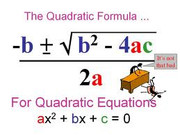
Quadratic Formula is attached for help. The b^2 - 4ac part under the square root is the DISCRIMINANT, once D is negative, we get no real solution for the variable L as taken by Mitch. If we take perimeter to be 28 or less, we'll keep getting a negative D, hence no real solution. That makes us believe that the perimeter of this rectangle R must have to be greater than 28. Hence, statement 1 is sufficient by its own.mariofelixpasku wrote:GMATGuruNY wrote:Statement 1:sanju09 wrote:Is the perimeter of rectangle R greater than 28?
(1) Area of rectangle R is 50.
(2) Diagonal of rectangle R is 10.
LW = 50.
Let's assume that the perimeter = 28.
Then 2(L+W) = 28, L+W=14, and W=14-L.
Substituting into LW=50, we get:
L(14-L) = 50.
14L - L^2 -50 = 0.
L^2 - 14L + 50 = 0.
For any quadratic equation in the form of ax^2 + bx + c, the determinant is b^2 - 4ac. If the determinant is negative, the equation has no real solutions. In the equation above, a=1, b= -14 and c=50. Since the determinant of the equation is b^2-4ac = (-14)^2 - 4*1*50 = 196-200 = -4, the equation does not have a real solution.
This shows us that in order for the equation above to have a real solution, the perimeter has to be greater than 28.
Sufficient.
Statement 2:
L^2 + W^2 = 100.
If L=6 and W=8, then p = 2*(6+8) = 28. Is the perimeter greater than 28? No.
If L=7 and W=√51, then p = 2*(7 + √51). Recognizing that √51>7, is the perimeter greater than 28? Yes.
Since the answer can be both no and yes, insufficient.
The correct answer is A.
Can you please explain why you can deduct that there is no solution if there is no solution for your equation? and why do you assume that the equation is = 28 ... when the original sentence states >28 ?

The mind is everything. What you think you become. -Lord Buddha
Sanjeev K Saxena
Quantitative Instructor
The Princeton Review - Manya Abroad
Lucknow-226001
www.manyagroup.com
Sanjeev K Saxena
Quantitative Instructor
The Princeton Review - Manya Abroad
Lucknow-226001
www.manyagroup.com
- NeilWatson
- Senior | Next Rank: 100 Posts
- Posts: 48
- Joined: Wed Oct 30, 2013 7:54 am
- Followed by:1 members
I understand your explanation for statement 2, but regarding statement 1 how do you know that based on all that calculation, the perimeter can't be less than 28 instead of greater?GMATGuruNY wrote:Statement 1:sanju09 wrote:Is the perimeter of rectangle R greater than 28?
(1) Area of rectangle R is 50.
(2) Diagonal of rectangle R is 10.
LW = 50.
Let's assume that the perimeter = 28.
Then 2(L+W) = 28, L+W=14, and W=14-L.
Substituting into LW=50, we get:
L(14-L) = 50.
14L - L^2 -50 = 0.
L^2 - 14L + 50 = 0.
For any quadratic equation in the form of ax^2 + bx + c, the determinant is b^2 - 4ac. If the determinant is negative, the equation has no real solutions. In the equation above, a=1, b= -14 and c=50. Since the determinant of the equation is b^2-4ac = (-14)^2 - 4*1*50 = 196-200 = -4, the equation does not have a real solution.
This shows us that in order for the equation above to have a real solution, the perimeter has to be greater than 28.
Sufficient.
Statement 2:
L^2 + W^2 = 100.
If L=6 and W=8, then p = 2*(6+8) = 28. Is the perimeter greater than 28? No.
If L=7 and W=√51, then p = 2*(7 + √51). Recognizing that √51>7, is the perimeter greater than 28? Yes.
Since the answer can be both no and yes, insufficient.
The correct answer is A.
- GMATGuruNY
- GMAT Instructor
- Posts: 15539
- Joined: Tue May 25, 2010 12:04 pm
- Location: New York, NY
- Thanked: 13060 times
- Followed by:1906 members
- GMAT Score:790
When p=28, the value of the determinant is negative because the value of b² (196) is TOO SMALL.NeilWatson wrote:Regarding statement 1, how do you know that based on all that calculation, the perimeter can't be less than 28 instead of greater?GMATGuruNY wrote:Statement 1:sanju09 wrote:Is the perimeter of rectangle R greater than 28?
(1) Area of rectangle R is 50.
(2) Diagonal of rectangle R is 10.
LW = 50.
Let's assume that the perimeter = 28.
Then 2(L+W) = 28, L+W=14, and W=14-L.
Substituting into LW=50, we get:
L(14-L) = 50.
14L - L^2 -50 = 0.
L^2 - 14L + 50 = 0.
For any quadratic equation in the form of ax^2 + bx + c, the determinant is b^2 - 4ac. If the determinant is negative, the equation has no real solutions. In the equation above, a=1, b= -14 and c=50. Since the determinant of the equation is b^2-4ac = (-14)^2 - 4*1*50 = 196-200 = -4, the equation does not have a real solution.
This shows us that in order for the equation above to have a real solution, the perimeter has to be greater than 28.
Sufficient.
If p<28, then the value of b² will become even SMALLER.
Case 2: p=20
Follow the values in red:
Since p = 2(L+W) = 20, L+W=10 and W=10-L.
Substituting W=10-L into LW=50, we get:
L(10-L) = 50.
10L - L² - 50 = 0.
L² - 10L + 50 = 0.
In this case, b² = 100, with the result that b² - 4ac = 100 - 4*1*50 = -100.
When p<28, the value of the determinant becomes MORE NEGATIVE.
Implication:
For the determinant to be NONNEGATIVE, p>28.
Private tutor exclusively for the GMAT and GRE, with over 20 years of experience.
Followed here and elsewhere by over 1900 test-takers.
I have worked with students based in the US, Australia, Taiwan, China, Tajikistan, Kuwait, Saudi Arabia -- a long list of countries.
My students have been admitted to HBS, CBS, Tuck, Yale, Stern, Fuqua -- a long list of top programs.
As a tutor, I don't simply teach you how I would approach problems.
I unlock the best way for YOU to solve problems.
For more information, please email me (Mitch Hunt) at [email protected].
Student Review #1
Student Review #2
Student Review #3
Followed here and elsewhere by over 1900 test-takers.
I have worked with students based in the US, Australia, Taiwan, China, Tajikistan, Kuwait, Saudi Arabia -- a long list of countries.
My students have been admitted to HBS, CBS, Tuck, Yale, Stern, Fuqua -- a long list of top programs.
As a tutor, I don't simply teach you how I would approach problems.
I unlock the best way for YOU to solve problems.
For more information, please email me (Mitch Hunt) at [email protected].
Student Review #1
Student Review #2
Student Review #3

-
nikhilgmat31
- Legendary Member
- Posts: 518
- Joined: Tue May 12, 2015 8:25 pm
- Thanked: 10 times
Answer is A.
This problem can be more difficult if it is given as 4 sided polygon rather than rectangle. than A& B are not sufficient. We need to go with C in that case.
- Max@Math Revolution
- Elite Legendary Member
- Posts: 3991
- Joined: Fri Jul 24, 2015 2:28 am
- Location: Las Vegas, USA
- Thanked: 19 times
- Followed by:37 members
In DS, Variable approach is the easiest and quickest way to find the answer without actually solving the problem.
Remember equal number of variables and equations ensures a solution.
In original condition, we have 2 variables because rectangle should know "length and width" so we need 2 equations. 1) and 2) are 2 equations. now it is sufficien so C is the answer.
Why C? If you know the logics of Variable approach, you can easily find the answer. You don't need to actually solve the problem.
www.mathrevolution.com
Our world's first Variable Approach (DS) and IVY Approach (PS) help students dramatically reduce their time spent per question and improve accuracy. You will have 10 min. to spare before the test ends.
Remember equal number of variables and equations ensures a solution.
In original condition, we have 2 variables because rectangle should know "length and width" so we need 2 equations. 1) and 2) are 2 equations. now it is sufficien so C is the answer.
Why C? If you know the logics of Variable approach, you can easily find the answer. You don't need to actually solve the problem.
www.mathrevolution.com
Our world's first Variable Approach (DS) and IVY Approach (PS) help students dramatically reduce their time spent per question and improve accuracy. You will have 10 min. to spare before the test ends.
- GMATGuruNY
- GMAT Instructor
- Posts: 15539
- Joined: Tue May 25, 2010 12:04 pm
- Location: New York, NY
- Thanked: 13060 times
- Followed by:1906 members
- GMAT Score:790
The correct answer is not C but A.Max@Math Revolution wrote:In DS, Variable approach is the easiest and quickest way to find the answer without actually solving the problem.
Remember equal number of variables and equations ensures a solution.
In original condition, we have 2 variables because rectangle should know "length and width" so we need 2 equations. 1) and 2) are 2 equations. now it is sufficien so C is the answer.
Why C? If you know the logics of Variable approach, you can easily find the answer. You don't need to actually solve the problem.
www.mathrevolution.com
Our world's first Variable Approach (DS) and IVY Approach (PS) help students dramatically reduce their time spent per question and improve accuracy. You will have 10 min. to spare before the test ends.
Statement 1 on its own is sufficient to determine that the perimeter of rectangle R must be greater than 28.
Private tutor exclusively for the GMAT and GRE, with over 20 years of experience.
Followed here and elsewhere by over 1900 test-takers.
I have worked with students based in the US, Australia, Taiwan, China, Tajikistan, Kuwait, Saudi Arabia -- a long list of countries.
My students have been admitted to HBS, CBS, Tuck, Yale, Stern, Fuqua -- a long list of top programs.
As a tutor, I don't simply teach you how I would approach problems.
I unlock the best way for YOU to solve problems.
For more information, please email me (Mitch Hunt) at [email protected].
Student Review #1
Student Review #2
Student Review #3
Followed here and elsewhere by over 1900 test-takers.
I have worked with students based in the US, Australia, Taiwan, China, Tajikistan, Kuwait, Saudi Arabia -- a long list of countries.
My students have been admitted to HBS, CBS, Tuck, Yale, Stern, Fuqua -- a long list of top programs.
As a tutor, I don't simply teach you how I would approach problems.
I unlock the best way for YOU to solve problems.
For more information, please email me (Mitch Hunt) at [email protected].
Student Review #1
Student Review #2
Student Review #3