Here is the question and the explanation.
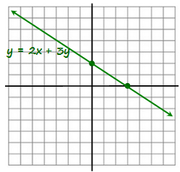
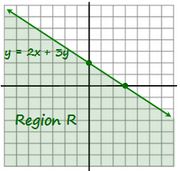
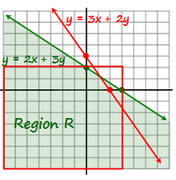
In the xy-plane, region R consists of all the points (x,y)
such that 2x + 3y =< 6. Is the point (r,s) in region R ?
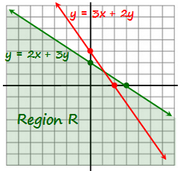
(1) 3r + 2s = 6
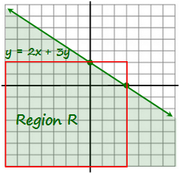
(2) r =< 3 and s =< 2
Both (r,s) = (2,0) and (r,s) = (0,3) satisfy the
equation 3r + 2s = 6, since 3(2) + 2(0) = 6
and 3(0) + 2(3)=6. However, 2(2) + 3(0) = 4,
so (2,0) is in region R, while 2(0) + 3(3) = 9,
so (0,3) is not in region R; NOT sufficient.
Both (r,s) = (0,0) and (r,s) = (3,2) satisfy
the inequalities r =< 3 and s =< 2. However,
2(0) + 3(0) = 0, so (0,0) is in region R, while
2(3) + 3(2) = 12, so (3,2) is not in region R;
NOT sufficient.
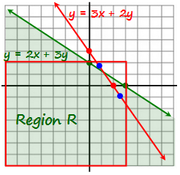
Taking (1) and (2) together, it can be seen that
both (r,s) = (0,0) and (r,s) = (1,1.5) satisfy
3r + 2s = 6, r =< 3 and s =< 2. However, 2(2) + 3(0) = 4,
so (2,0) is in region R, while 2(1) + 3(1.5) = 6.5,
so (1,1.5) is not in region R.
Therefore, (1) and (2) together are not sufficient.
Is there a simpler, easier to follow explanation, please?
In the xy-plane, region R consists of all the points (x,y)
such that 2x + 3y =< 6. Is the point (r,s) in region R ?
(1) 3r + 2s = 6
(2) r =< 3 and s =< 2
Both (r,s) = (2,0) and (r,s) = (0,3) satisfy the
equation 3r + 2s = 6, since 3(2) + 2(0) = 6
and 3(0) + 2(3)=6. However, 2(2) + 3(0) = 4,
so (2,0) is in region R, while 2(0) + 3(3) = 9,
so (0,3) is not in region R; NOT sufficient.
Both (r,s) = (0,0) and (r,s) = (3,2) satisfy
the inequalities r =< 3 and s =< 2. However,
2(0) + 3(0) = 0, so (0,0) is in region R, while
2(3) + 3(2) = 12, so (3,2) is not in region R;
NOT sufficient.
Taking (1) and (2) together, it can be seen that
both (r,s) = (0,0) and (r,s) = (1,1.5) satisfy
3r + 2s = 6, r =< 3 and s =< 2. However, 2(2) + 3(0) = 4,
so (2,0) is in region R, while 2(1) + 3(1.5) = 6.5,
so (1,1.5) is not in region R.
Therefore, (1) and (2) together are not sufficient.
Is there a simpler, easier to follow explanation, please?