BREAKING: Target Test Prep releases Brand New 2026 On Demand GMAT prep course

Redeem

In the xy-plane, line k passes through

Expert replies
by NandishSS » Fri Sep 02, 2016 4:49 am
In the xy-plane, line k passes through the point (1, 1) and line m passes through the point (1, -1). Are the lines k and m perpendicular to each other ?

(1) Lines k and m intersect at the point (1, -1)
(2) Line k intersects the x-axis at the point (1, 0)

OA:E
Join the discussion
Source: — Data Sufficiency |

by DavidG@VeritasPrep » Fri Sep 02, 2016 8:36 am
NandishSS wrote:In the xy-plane, line k passes through the point (1, 1) and line m passes through the point (1, -1). Are the lines k and m perpendicular to each other ?

(1) Lines k and m intersect at the point (1, -1)
(2) Line k intersects the x-axis at the point (1, 0)

OA:E
Rephrase: Are the slopes of line k and line m negative reciprocals?

1) This allows to calculate the slope of line k, as we have two points on this line. ('change in y'/'change in x' = [1-(-1])/1-1 = 2/0 or undefined. It's a vertical line, so we want to know if the slope of line m is 0, or a horizontal line.) But we can't calculate the slope of line m, as we have only one point on this line, and thus have no way of determining if the lines are perpendicular.

2) This gives us the same info as the first statement. We know line k is a vertical line. But we don't know the slope of line m.

The answer is E
Veritas Prep | GMAT Instructor

Veritas Prep Reviews
Save $100 off any live Veritas Prep GMAT Course
Join the discussion

by Brent@GMATPrepNow » Tue Sep 06, 2016 3:02 pm
NandishSS wrote:In the xy-plane, line k passes through the point (1, 1) and line m passes through the point (1, -1). Are the lines k and m perpendicular to each other ?

(1) Lines k and m intersect at the point (1, -1)
(2) Line k intersects the x-axis at the point (1, 0)

OA:E
Target question: Are lines K and m perpendicular to each other?

IMPORTANT: Since line K passes through the point (1, 1), statements 1 and 2 both have the same effect of "locking" line K into exactly one position. In fact, statements 1 and 2 essentially provide the exact same information. As such, it's either the case that each statement ALONE is sufficient (D) or the statements COMBINED are not sufficient (E).

Since neither statement locks line M into any certain position, line M is free to be in lots of different positions, as long as it passes through the point (1, -1)


Okay, let's jump right to . . .
Statements 1 and 2 combined:
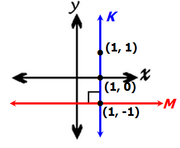
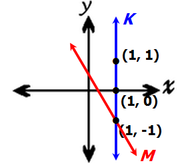
Here are two possible scenarios that satisfy statements 1 and 2.
Scenario a:
Image
In this instance, lines M and K are perpendicular.


Scenario b:
Image
In this instance, lines M and K are not perpendicular.


Since we cannot answer the target question with certainty, the combined statements are NOT SUFFICIENT

Answer = E

Cheers,
Brent
Brent Hanneson - Creator of GMATPrepNow.com
Image
Join the discussion


















