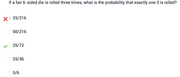
A fair 6-sided die

This topic has expert replies
Source: — Problem Solving |

GMAT/MBA Expert

User avatar
Elite Legendary Member
Posts: 10392
Joined: Sun Jun 23, 2013 6:38 pm
Location: Palo Alto, CA
Thanked: 2867 times
Followed by:511 members
GMAT Score:800

by [email protected] » Sun Feb 21, 2016 8:28 pm
Hi didieravoaka,

You can approach the math in this question in a couple of different ways, so you have to think about what would be the easiest way for YOU to organize your work.

The questions tells us to roll a 6-sided dice 3 times. We're asked for the probability of rolling EXACTLY one '3' on those three rolls.

Here's a way to break the calculation down into 3 smaller calculations:

(first roll is 3)(second roll is NOT 3)(third roll is NOT 3) = (1/6)(5/6)(5/6) = 25/216

(first roll is NOT 3)(second roll is 3)(third roll is NOT 3) = (5/6)(1/6)(5/6) = 25/216

(first roll is NOT 3)(second roll is NOT 3)(third roll is 3) = (5/6)(5/6)(1/6) = 25/216

Total = 3(25/216) = 75/216 = 25/72

Final Answer: C

GMAT assassins aren't born, they're made,
Rich
Contact Rich at [email protected]
Image

GMAT/MBA Expert

User avatar
GMAT Instructor
Posts: 2095
Joined: Tue Dec 04, 2012 3:22 pm
Thanked: 1443 times
Followed by:247 members

by ceilidh.erickson » Mon Feb 22, 2016 8:00 am
If you picked 25/216, that indicates that you weren't thinking about the order. You probably tested for (first roll is a 3)(second roll NOT a 3)(3rd roll NOT a 3).

On probability questions, you should ask yourself "what is this the probability of?" before answering the question. If you had realized that you had found (first roll is a 3)(2nd roll NOT a 3)(3rd roll NOT a 3), you could have realized that there were 2 other orders that would work: a 3 on the 2nd roll only, or a 3 on the 3rd roll only. You could then multiply 25/216 by 3, to get 75/216 --> 25/72.
Ceilidh Erickson
EdM in Mind, Brain, and Education
Harvard Graduate School of Education