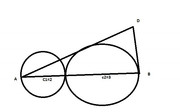
akhilpahuja wrote:Two circle C1 and C2 of radius 2 and 3 respectively touch each other as shown in the figure. If AD and BD are tangents the the length of BD is
(A) 3(6)^1/2
(B) 5(6)^1/2
(C) 7(6)^1/2
(D) 6
(E) 5(3)^1/2
Dear
Akhilpahuja,
I'm happy to help with this.
Here are a couple blogs in which I discuss related material:
https://magoosh.com/gmat/2012/circle-and ... -the-gmat/
https://magoosh.com/gmat/2012/inscribed- ... -the-gmat/
I agree with
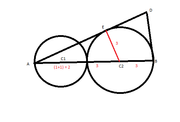
ganeshrkamath --- as the question is stated, the correct answer is not here. Here is a solution of the question, as stated. Refer to the diagram, which is drawn to scale.
We construct (C2)E, which forms a right angle, because a radius is always perpendicular to a tangent at the point of tangency. We know (C2)E = 3, because it's a radius of a circle. A(C2) = 7, and we can find AE by the Pythagorean Theorem.
(AE)^2 + 3^2 = 7^2
(AE)^2 + 9 = 49
(AE)^2 = 40
AE = sqrt(40) = 2*sqrt(10)
Now, we take advantage of the proportionality between the similar triangles. Triangle AE(C2) is proportional to triangle ADB, in that order of proportionality. The angles at A are the same, and the right angles are congruent (this is a rule in Geometry known as AA Similarity). The sides of similar triangles are proportional, so we can set up a proportion:
(BD)/(AD) = [(C2)E]/AE
BD/10 = 3/(2*sqrt(10))
BD = (3/2)*10/sqrt(10) = (3/2)*sqrt(10)
That length for BD is not listed.
I will say, this problem, as it current stands, is a bit difficult for a GMAT problem. This would really be at the outer edge of what the GMAT would expect you to know.
Meanwhile, I thought
ganeshrkamath suggested a brilliant simple edit --- just changing the radius of the first circle from 2 to 1 (alternately, changing radius = 2 to diameter = 2), makes the problem extraordinarily elegant, much like a real GMAT problem. I don't know if what the source is, but I would surprised if
ganeshrkamath is not correct.
I hope this helps.
Mike