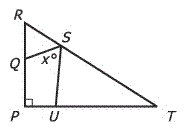
In the figure shown, what is the value of x?
(1) The length of line segment QR is equal to the length of line segment RS.
(2) The length of line segment ST is equal to the length of line segment TU.
Statement 1 tells us that triangle QRS is an isosceles triangle. All this means though is that we have cut across the corner of a triangle. Angle R could have any measure less than 90 degrees, so the angles of intersection at Q and S could have various measures. Also we have no information that allows us to determine the measures of the angles of intersection of segment SU and the sides of the triangle.
So Statement 1 is insufficient.
Statement 2 on its own is like Statement 1, telling us that triangle STU is isosceles without giving us enough information to determine what any of the angles actually are.
When we combine the statements, something interesting happens.
Since we know that the measure of angle P is 90 degrees, we know that the combined measures of angle R and angle T add up to 90 degrees, because all the measures of the interior angles of a triangle add up to 180 degrees.
Since the measures of R and T add up to 90 degrees, the measures of the other four angles of the two isosceles triangles, QRS and STU, have to add up to (2 x 180) - 90 = 270 degrees. Further, if we take one of each of the base angles of the two isosceles triangles, their measures have to add up to 270/2 = 135 degrees.
So even though we have no way of determining the measures of angle RSQ and angle UST, we can determine that angle RSQ + angle UST = 135 degrees.
Combined, x + angle RSQ + angle UST = 180 degrees.
So x = 180 - 135 = 45 degrees.
Thus, even though there is no way to determine what the measures of most of the angles involved are, combined the statements are sufficient for determining the measure of angle x.
So the correct answer is
C.
























