danielle07 wrote:How to do the proper solution to it?
Many students fall into the trap of believing that GMAT quant questions should be solved using the techniques they learned in school. On the GMAT, the best solution is the one that helps us identify the correct answer as quickly as possible.
Here's my solution (with an added graphic to help see what's going on):
The entire exterior of a large wooden cube is painted red, and then the cube is sliced into n³ smaller cubes (where n > 2). Each of the smaller cubes is identical. In terms of n, how many of these smaller cubes have been painted red on at least one of their faces?
A) 6n²
B) 6n² - 12n + 8
C) 6n² - 16n + 24
D) 4n²
E) 24n - 24
Okay, a fast approach here is to examine a specific case (i.e., a specific value of n) and compare the result to the answer choices.
So, let's take a wooden cube and slice it into
3³ smaller cubes (i.e., n =
3).
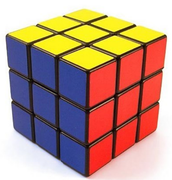
There are 27 smaller cubes altogether, and ONLY 1 of them (the small cube in the very center) does not have paint on it. So, there are
26 cubes that have paint on them.
So, when n = 3, there are 26 cubes that have paint on them.
Now, we'll check the answer choices and see which one yields a value of
26 when n =
3
A) 6(
3)² =
54 NOPE
B) 6(
3)² - 12(
3) + 8 =
26 PERFECT!
C) 6(
3)² - 16(
3) + 24 =
30 NOPE
D) 4(
3)² =
36 NOPE
E) 24(
3) - 24 =
48 NOPE
Answer:
B
Cheers,
Brent
Brent Hanneson - Creator of GMATPrepNow.com


























