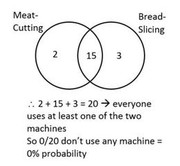
chiphipoke wrote:Of the 20 members of a kitchen crew, 17 can use the meat-cutting machine, 18 can use the bread-slicing machine, and 15 can use both machines. If one member of the crew is to be chose at random, what is the probability that the member chosen will be someone who
cannot use either machine?
We can use the following formula for two overlapping groups:
Total = Group 1 + Group 2 - Both + Neither.
The big idea with overlapping groups is to SUBTRACT THE OVERLAP.
When we count everyone in Group 1 (meat-cutters) and everyone in Group 2 (bread-slicers), those in BOTH groups (members who can use BOTH types of machines) get counted twice.
So that we don't double-count the members in both groups, we SUBTRACT THE OVERLAP from the total.
In the problem at hand:
Total = 20.
Group 1 = meat-cutters = 17.
Group 2 = bread-slicers = 18.
Both = 15.
Let N = the number who can use neither type of machine.
Plugging these values into the equation above, we get:
20 = 17 + 18 - 15 + N
N = 0.
Since 0 members can use neither type of machine, P(selecting a member who can use neither type of machine) = 0.
The correct answer is
A.
Private tutor exclusively for the GMAT and GRE, with over 20 years of experience.
Followed here and elsewhere by over 1900 test-takers.
I have worked with students based in the US, Australia, Taiwan, China, Tajikistan, Kuwait, Saudi Arabia -- a long list of countries.
My students have been admitted to HBS, CBS, Tuck, Yale, Stern, Fuqua -- a long list of top programs.
As a tutor, I don't simply teach you how I would approach problems.
I unlock the best way for YOU to solve problems.
For more information, please email me (Mitch Hunt) at
[email protected].
Student Review #1
Student Review #2
Student Review #3