A Geometry Q from GMATPrep S/w

This topic has expert replies
User avatar
Junior | Next Rank: 30 Posts
Posts: 20
Joined: Mon Aug 29, 2011 6:04 am
Thanked: 3 times
Followed by:4 members

A Geometry Q from GMATPrep S/w

by Digvijay01 » Sun Dec 08, 2013 8:37 pm
HI All,
Please help me ans this question. This is a GMATPrep free CAT question. I have attacjed fig. It's not exactly same, but I'll try to explain as much as possible.

In the fig. , 2 lines from points A and B are perpendicular to each other and are of same length. If coordinates of pt A are (-(3)^1/2 , 1), what is the x-coordinate of point B.

1. 3^1/2
2. 1


Note: In actual Qs, these lines are in a semi-circle, unable to draw one here :( . Please mention if it might change some result, according to me it should not. Also, I only remember 2 options, 1 is right and 1 is wrong. Will reveal after some discussion.

Thanks in advance.
Attachments
fig1.jpg
Source: — Problem Solving |

GMAT/MBA Expert

User avatar
Elite Legendary Member
Posts: 10392
Joined: Sun Jun 23, 2013 6:38 pm
Location: Palo Alto, CA
Thanked: 2867 times
Followed by:511 members
GMAT Score:800

by [email protected] » Sun Dec 08, 2013 10:42 pm
Hi Digvijay01,

In co-ordinate geometry/graphing questions it's important to remember that ANY diagonal line is the hypotenuse of a right triangle (you just have to DRAW in the right triangle).

Draw a line "down" from point A to the X-axis. You now have a right triangle with a base of (root3) and a height of 1. This is a 30/60/90 triangle and you can determine that the line OA has a length of 2. The angle next to the Origin is 30 degrees.

Now, draw a line "down" from point B to the X-axis. You have another right triangle with a hypotenuse of 2.

Since the X-axis is a straight line, it totals 180 degrees and it's made up of 3 angles.

The first = 30 degrees (from the triangle on the left
The second = 90 degrees (from the picture
The third = ????

30 + 90 + X = 180, so the third angle must = 60 degrees.

The triangle on the right is ALSO a 30/60/90. Using the hypotenuse of 2 and the two angles, you can figure out the base and the height of this triangle. Thus, the co-ordinate of point B is (1, root3).

GMAT assassins aren't born, they're made,
Rich
Contact Rich at [email protected]
Image

Master | Next Rank: 500 Posts
Posts: 447
Joined: Fri Nov 08, 2013 7:25 am
Thanked: 25 times
Followed by:1 members

by Mathsbuddy » Sun Dec 08, 2013 11:33 pm
The gradient of a normal (perpendicular) to a line with gradient m is equal to -1/m
Using the equation of a line y = mx + c and knowning that c = 0 (through the origin),
then if the first line has co-ordinates (x, mx) at a fixed distance from O, then the perpendicular will have co-ordinates (mx, -x) at the same fixed distance from O.

So the answer is 1.
Last edited by Mathsbuddy on Sun Dec 08, 2013 11:41 pm, edited 1 time in total.

Master | Next Rank: 500 Posts
Posts: 447
Joined: Fri Nov 08, 2013 7:25 am
Thanked: 25 times
Followed by:1 members

by Mathsbuddy » Sun Dec 08, 2013 11:41 pm
Another method:

If a square is rotated about one vertex at the origin, starting off flat against the negative x-axis, then every (x,y) change on the horizontal sides will be duplicated as a (y, -x) change by corresponding points on the vertical sides. In other words, rotation from the x-axis = rotation from the y-axis and the x and y coordinates are interchanged.

Answer = 1

User avatar
GMAT Instructor
Posts: 15539
Joined: Tue May 25, 2010 12:04 pm
Location: New York, NY
Thanked: 13060 times
Followed by:1906 members
GMAT Score:790

by GMATGuruNY » Mon Dec 09, 2013 4:47 am
krnverma wrote:Image

In the figure above, points P and Q lie on the circle with center O. What is the value of S?

a)1/2
b)1
c)Root 2
d)Root 3
e)(Root 2)/2
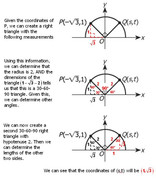
The sides of a 30-60-90 triangle are proportioned x : x√3 : 2x.
Whenever you see √3 in a geometry question, look for -- or DRAW -- a 30-60-90 triangle.
(-√3, 1) implies a vertical distance of 1 and a horizontal distance of √3.
These distances can serve to form the legs of a 30-60-90 triangle with sides of 1, √3, and 2.
The result is the following figure.
Image

The correct answer is B.
Private tutor exclusively for the GMAT and GRE, with over 20 years of experience.
Followed here and elsewhere by over 1900 test-takers.
I have worked with students based in the US, Australia, Taiwan, China, Tajikistan, Kuwait, Saudi Arabia -- a long list of countries.
My students have been admitted to HBS, CBS, Tuck, Yale, Stern, Fuqua -- a long list of top programs.

As a tutor, I don't simply teach you how I would approach problems.
I unlock the best way for YOU to solve problems.

For more information, please email me (Mitch Hunt) at [email protected].
Student Review #1
Student Review #2
Student Review #3

GMAT/MBA Expert

User avatar
GMAT Instructor
Posts: 16207
Joined: Mon Dec 08, 2008 6:26 pm
Location: Vancouver, BC
Thanked: 5254 times
Followed by:1268 members
GMAT Score:770

by Brent@GMATPrepNow » Mon Dec 09, 2013 7:09 am
Image

In the figure above, points P and Q lie on the circle with center O. What is the value of S?

a) 1/2
b) 1
c) √2
d) √3
e) (√2)/2
Here's an approach that's similar to Mitch's (with a couple of extra steps explained):
Image

So, s = 1
Answer: B

Cheers,
Brent
Brent Hanneson - Creator of GMATPrepNow.com
Image