BREAKING: Target Test Prep releases Brand New 2026 On Demand GMAT prep course

Redeem

OG 13 #156

Problem Solving — algebra and arithmetic (GMAT Focus Edition)
Expert replies
by jeph86 » Wed Feb 24, 2016 9:11 am
S= (2/n)/(1/x + 3/3x)

156. in the expression above, if xn is not equal 0, what is the value of S

1) x=2n
2) n= 1/2

can someone help. I am still lost with the book explanation. thanks in advance.
Join the discussion
Source: — Quantitative Reasoning |

by [email protected] » Wed Feb 24, 2016 9:43 am
Hi jeph86,

To start, there's a minor typo in your post. The equation should read:

S= (2/n)/(1/x + 2/3x)

We're told that XN is not equal to 0 (so neither of those variables can be 0). We're asked for the value of S. This question can be solved by TESTing VALUES.

1) x = 2n

IF....
n = 1
x = 2
(2/1)/(1/2 + 2/6) = 2/(1/2 + 1/3) = 2/(5/6) = 12/5

IF....
n = 2
x = 4
(2/2)/(1/4 + 2/12) = 1/(1/4 + 1/6) = 1/(5/12) = 12/5

IF...
n = -3
x = -6
(2/-3)/(-1/6 - 2/18) = (-2/3)(-1/6 - 1/9) = (-2/3)/(-5/18) = +36/15 = 12/5

The answer to the question is ALWAYS 12/5.
Fact 1 is SUFFICIENT

2) n = 1/2

This Fact tells us NOTHING about the value of x. As x changes, the value of S will change.
Fact 2 is INSUFFICIENT

Final Answer: A

GMAT assassins aren't born, they're made,
Rich
Contact Rich at [email protected]
Image
Join the discussion

by jeph86 » Wed Feb 24, 2016 11:12 am
Hi Rich,

it seems like when I test n=1 x=4, it gives me a different solution. the result is 24/5. in your explanation, you said the answer will always 12/5. can you explain
Join the discussion

by [email protected] » Wed Feb 24, 2016 8:55 pm
Hi jeph86,

In Fact 1, we're given the extra information that x=2n, so you CANNOT use n=1, x=4 as a TEST case. You have to use values that fit the equation x=2n. Any pair of values that fit THAT equation will also produce the result 12/5 in the original question.

GMAT assassins aren't born, they're made,
Rich
Contact Rich at [email protected]
Image
Join the discussion

by jeph86 » Thu Feb 25, 2016 12:47 pm
I appreciate your explanation Rich. this make sense.
Join the discussion

by ceilidh.erickson » Sun Feb 28, 2016 5:00 pm
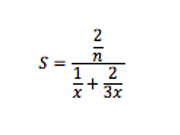
Try simplifying the question before approaching the statements. We're given:

Image

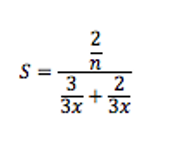
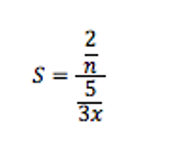
Start by simplifying the denominator. We can add the two fractions together if we use a common denominator of 3x:

Image

Image

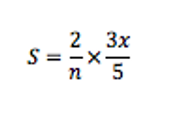
To divide one fraction by another fraction, flip and multiply by the reciprocal:

Image

Image

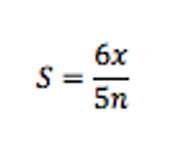
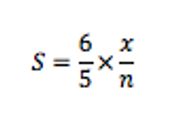
If we know that S = 6x/5n, we can split it into:

Image

Thus, if we want to know the value of S, all we need is the value of x/n.

Statement (1), if we rearrange it, gives us x/n = 2. This is sufficient.

Statement (2) gives us a value for n, but tells us nothing about its relationship to x. Insufficient.

The answer is A.
Ceilidh Erickson
EdM in Mind, Brain, and Education
Harvard Graduate School of Education
Join the discussion

by ceilidh.erickson » Sun Feb 28, 2016 5:06 pm
Here is some general advice about DS problems like this one: if it feels too obvious that using both statements together will give you an answer, then it's probably not C. This is what we call a C-Trap.

In this case, if you knew that n = 1/2, you could clearly plug it into x = 2n, and clearly x = 1. We have all of the values we need, but we haven't done any conceptual thinking! That's our signal to be skeptical: could either statement be sufficient on its own? If we rephrase properly, we see that statement (1) is enough, so we don't need to put the 2 statements together. The answer must be A.

For more on how to avoid C-Traps, read these articles:
https://www.manhattanprep.com/gmat/blog ... fficiency/
https://www.manhattanprep.com/gmat/blog ... ncy-traps/
Ceilidh Erickson
EdM in Mind, Brain, and Education
Harvard Graduate School of Education
Join the discussion