rectangular solid crushing me!!

This topic has expert replies
Source: — Data Sufficiency |

User avatar
Master | Next Rank: 500 Posts
Posts: 434
Joined: Mon Jun 11, 2007 9:48 pm
Location: Bangalore
Thanked: 6 times
GMAT Score:600

by viju9162 » Tue Sep 22, 2009 3:29 am
Is the answer "A" ?

From (1), Two adjacent faces of the solid have areas 15 and 24, respectively.

We can understand that these two sides will have common height... Therefore,

15 = 5*3
24 = 8*3

hence, 8 will be length, 5 will be width, and 3 will be height...

V = L*W*H
V = 8*5*3 = 120 ...

From (2), we will get to know about one face and not about other sides..

please let me know whether my reasoning is right...
"Native of" is used for a individual while "Native to" is used for a large group

Master | Next Rank: 500 Posts
Posts: 189
Joined: Thu Apr 03, 2008 2:03 pm
Location: USA
Thanked: 21 times

by rohan_vus » Tue Sep 22, 2009 4:04 am
A cant be the answer

You took 15 = 5 * 3 and 24 = 8 * 3 .
Consider this , 15 = 7.5 * 2 and 24 = 12 * 2.
So height is 2 now and hence the volume which comes out now is 180 .

Or

15 = 15 * 1 and 24 = 24 * 1 , in which cases the height is 1 and the volume = 360 ... Thus A is not sufficient

Answer should be C

User avatar
Master | Next Rank: 500 Posts
Posts: 434
Joined: Mon Jun 11, 2007 9:48 pm
Location: Bangalore
Thanked: 6 times
GMAT Score:600

by viju9162 » Tue Sep 22, 2009 4:17 am
Hi rohan_vus,

In that case, from statement (1)

15 = 15*1
24 = 24*1

And from statement (2),

40 = 40*1 ..

Therefore, A = 15*24*1 = 360 ...


Regards,
Viju
"Native of" is used for a individual while "Native to" is used for a large group

Master | Next Rank: 500 Posts
Posts: 189
Joined: Thu Apr 03, 2008 2:03 pm
Location: USA
Thanked: 21 times

by rohan_vus » Tue Sep 22, 2009 4:27 am
In any case from statement 1 you have different volumes coming 360 or 120 as seen in above posts , so A is definitely ruled out.

Also stmnt 2 alsone is also not going to suffice.

1) Fro stmnt 1 --> say H*B = 15 and H*L = 24


) From stmnt 2 --> L*B = 40

Multiply eqn(1 )and eqn(2) , you get , (L*B*H)^2 = 15*24*40
==>Volume = L*B*H = 120 ..suffcient

User avatar
Master | Next Rank: 500 Posts
Posts: 434
Joined: Mon Jun 11, 2007 9:48 pm
Location: Bangalore
Thanked: 6 times
GMAT Score:600

by viju9162 » Tue Sep 22, 2009 6:56 am
Hi Rohan,

I'm still not convinced, but the above equation makes sense..

From statemnt(1)& statement (2), we are having 3 areas ( 15,24,40) .. and the only common factor is 1 ...

From your conclusion, you took From stmnt 2 --> L*B = 40 , this can be H*B = 40 ...

Please let me know whether my reasoning is wrong..

Thank you,
Viju
"Native of" is used for a individual while "Native to" is used for a large group

GMAT/MBA Expert

User avatar
GMAT Instructor
Posts: 16207
Joined: Mon Dec 08, 2008 6:26 pm
Location: Vancouver, BC
Thanked: 5254 times
Followed by:1268 members
GMAT Score:770
ashish1354 wrote:What is the volume of a certain rectangular solid?

(1) Two adjacent faces of the solid have areas 15 and 24, respectively.

(2) Each of two opposite faces of the solid has area 40.
Target question: What is the volume of a certain rectangular solid?

Aside: A rectangular solid is a box

Statement 1: Two adjacent faces of the solid have areas 15 and 24, respectively.
There are several different rectangular solids that meet this condition. Here are two:
Case a: the dimensions are 1x15x24, in which case the volume is 360
Case b: the dimensions are 3x5x8, in which case the volume is 120
Since we cannot answer the target question with certainty, statement 1 is NOT SUFFICIENT

Statement 2: Each of two opposite faces of the solid has area 40.
So, there are two opposite faces that each have area 40.
Definitely NOT SUFFICIENT

Statements 1 and 2 combined:
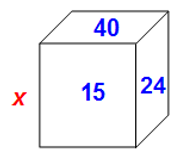
So, we know the area of each face (noted in blue on the diagram below).
Let's let x equal the length of one side.
Image


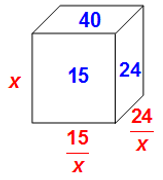
Since the area of each face = (length)(width), we can express the other two dimensions in terms of x.
Image

From here, we'll focus on the face that has area 40.
This face has dimensions (15/x) by (24/x)
Since the area is 40, we know that (15/x)(24/x) = 40
Expand: 360/(x^2) = 40
Simplify: 360 = 40x^2
Simplify: 9 = x^2
Solve: x = 3 or -3
Since the side lengths must be positive, we can be certain that x = 3

When we plug x=3 into the other two dimensions, we get 15/3 and 24/3
So, the 3 dimensions are 3, 5, and 8, which means the volume of the rectangular solid must be 120.
Since we can answer the target question with certainty, the combined statements are SUFFICIENT

Answer = C

Cheers,
Brent
Last edited by Brent@GMATPrepNow on Mon Mar 07, 2016 7:52 am, edited 1 time in total.
Brent Hanneson - Creator of GMATPrepNow.com
Image

User avatar
Master | Next Rank: 500 Posts
Posts: 434
Joined: Mon Jun 11, 2007 9:48 pm
Location: Bangalore
Thanked: 6 times
GMAT Score:600

by viju9162 » Tue Sep 22, 2009 8:25 am
Thank you Brent and rohan_vus


Regards,
Viju
"Native of" is used for a individual while "Native to" is used for a large group

Legendary Member
Posts: 641
Joined: Tue Feb 14, 2012 3:52 pm
Thanked: 11 times
Followed by:8 members

by gmattesttaker2 » Wed May 15, 2013 8:02 pm
Brent@GMATPrepNow wrote:
ashish1354 wrote:What is the volume of a certain rectangular solid?

(1) Two adjacent faces of the solid have areas 15 and 24, respectively.

(2) Each of two opposite faces of the solid has area 40.
We can see that (1) is not sufficient if we consider two sets of dimensions: 1x15x24 and 3x5x8

(2) is definitely not sufficient.

To check statements(1) and (2) combined, let's let x be the length of one side of our box (see below).

As you can see, statements (1) and (2) combined lead us to conclude that x=3, from which the other 2 lengths can be calculated. So, the answer is C.
Image

Hello Brent,

Thank you very much for the explanation. I had a question about Statement 2. When it says "Each of two opposite faces of the solid has area 40"

does it mean only 2 opposite faces (any 2 only) i.e. similar to Diagram 2 or does it mean all 2 opposite faces (all 6 faces in all) i.e. similar to Diagram 1?

Thanks again for your help.

Best Regards,
Sri
Attachments
Diagram 1.png
Diagram 2.png

GMAT/MBA Expert

User avatar
GMAT Instructor
Posts: 16207
Joined: Mon Dec 08, 2008 6:26 pm
Location: Vancouver, BC
Thanked: 5254 times
Followed by:1268 members
GMAT Score:770

by Brent@GMATPrepNow » Wed May 15, 2013 10:06 pm
Hi Sri,

I think statement 2 means that there are exactly 2 faces with area 40.
That said, it doesn't really matter for this question since statement 2 is insufficient, and statement 1 rules out the possibility of more than 2 faces having area 40.

Cheers,
Brent

Brent Hanneson - Creator of GMATPrepNow.com
Image

Legendary Member
Posts: 641
Joined: Tue Feb 14, 2012 3:52 pm
Thanked: 11 times
Followed by:8 members

by gmattesttaker2 » Wed May 15, 2013 10:43 pm
Brent@GMATPrepNow wrote:Hi Sri,

I think statement 2 means that there are exactly 2 faces with area 40.
That said, it doesn't really matter for this question since statement 2 is insufficient, and statement 1 rules out the possibility of more than 2 faces having area 40.

Cheers,
Brent

Hello Brent,

Hope all is well. Thanks a lot for your prompt reply and for the clarification.

Best Regards,
Sri

Junior | Next Rank: 30 Posts
Posts: 15
Joined: Sun Dec 16, 2012 4:04 am

by Captchar » Thu May 16, 2013 1:06 am
Brent@GMATPrepNow wrote:I think statement 2 means that there are exactly 2 faces with area 40.
That said, it doesn't really matter for this question since statement 2 is insufficient, and statement 1 rules out the possibility of more than 2 faces having area 40.
Hi Brent,

Stumbled upon this thread while searching for a discussion on this problem as I have some doubt on this.

Can you explain how statement 2 is individually insufficient? I understand that both statements together, it is not possible that more than a pair of opposite faces can have area 40. But statement 2 individually looks like trying to say 'each of two opposite faces of the solid has area 40' or each opposite faces have area 40 or all the faces of the solid has area 40. It never says exactly one pair of opposite faces have area 40.

Regards,
Charan

GMAT/MBA Expert

User avatar
GMAT Instructor
Posts: 16207
Joined: Mon Dec 08, 2008 6:26 pm
Location: Vancouver, BC
Thanked: 5254 times
Followed by:1268 members
GMAT Score:770

by Brent@GMATPrepNow » Thu May 16, 2013 7:14 am
Captchar wrote:
Brent@GMATPrepNow wrote:I think statement 2 means that there are exactly 2 faces with area 40.
That said, it doesn't really matter for this question since statement 2 is insufficient, and statement 1 rules out the possibility of more than 2 faces having area 40.
Hi Brent,

Stumbled upon this thread while searching for a discussion on this problem as I have some doubt on this.

Can you explain how statement 2 is individually insufficient? I understand that both statements together, it is not possible that more than a pair of opposite faces can have area 40. But statement 2 individually looks like trying to say 'each of two opposite faces of the solid has area 40' or each opposite faces have area 40 or all the faces of the solid has area 40. It never says exactly one pair of opposite faces have area 40.

Regards,
Charan
(2) Each of two opposite faces of the solid has area 40.

It doesn't really matter whether it's possible for more than 2 faces to have an area of 40, since it doesn't change the fact that statement 2 is not sufficient.
Consider these two conflicting cases:
case a: the dimensions are 10x10x4 (four faces with area 40), in which case the volume is 400
case b: the dimensions are 10x4x3 (two faces with area 40), in which case the volume is 120

Cheers,
Brent

Brent Hanneson - Creator of GMATPrepNow.com
Image

Junior | Next Rank: 30 Posts
Posts: 15
Joined: Sun Dec 16, 2012 4:04 am

by Captchar » Thu May 16, 2013 9:52 am
Brent@GMATPrepNow wrote:It doesn't really matter whether it's possible for more than 2 faces to have an area of 40, since it doesn't change the fact that statement 2 is not sufficient.
Consider these two conflicting cases:
case a: the dimensions are 10x10x4 (four faces with area 40), in which case the volume is 400
case b: the dimensions are 10x4x3 (two faces with area 40), in which case the volume is 120
Thanks for your reply!

But my question was different.
I was asking that doesn't statement individually means all the faces of the solid has area 40? I'm saying this because the statement says "each of two opposite faces..." not just simply "two opposite faces..." in which we could've interpreted that either 2 or 4 or 6 opposite faces are having area 40.

But by saying "each of two opposite faces..." don't we mean each pair of opposite faces or all the faces? In which case, only one such rectangular solid is possible and statement 2 by itself is sufficient to answer the question.

Regards,
Charan

GMAT/MBA Expert

User avatar
GMAT Instructor
Posts: 16207
Joined: Mon Dec 08, 2008 6:26 pm
Location: Vancouver, BC
Thanked: 5254 times
Followed by:1268 members
GMAT Score:770

by Brent@GMATPrepNow » Thu May 16, 2013 10:08 am
Captchar wrote:
Brent@GMATPrepNow wrote:It doesn't really matter whether it's possible for more than 2 faces to have an area of 40, since it doesn't change the fact that statement 2 is not sufficient.
Consider these two conflicting cases:
case a: the dimensions are 10x10x4 (four faces with area 40), in which case the volume is 400
case b: the dimensions are 10x4x3 (two faces with area 40), in which case the volume is 120
Thanks for your reply!

But my question was different.
I was asking that doesn't statement individually means all the faces of the solid has area 40? I'm saying this because the statement says "each of two opposite faces..." not just simply "two opposite faces..." in which we could've interpreted that either 2 or 4 or 6 opposite faces are having area 40.

But by saying "each of two opposite faces..." don't we mean each pair of opposite faces or all the faces? In which case, only one such rectangular solid is possible and statement 2 by itself is sufficient to answer the question.

Regards,
Charan
Ah, sorry for misinterpreting your question.

"Each of two opposite faces of the solid has area 40" is the same as saying "Two opposite faces of the solid each has area 40"
So, this does not necessarily mean that every face has area 40.

Cheers,
Brent
Brent Hanneson - Creator of GMATPrepNow.com
Image















