


Hello. Ive been reading this problem over and over again, but I think my confusion must come from the wording of each of the statements rather than the math. From the following problem:
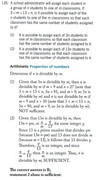
I understand that a group of students will be divided into m groups of size n. Thus, n students per classroom. Total students nxm.
Additionally, the inequality implies that there is a number of classrooms m, between 4 and 12 inclusive. Each group of n students can be equal or greater than 14.
The goal is to determine if n can be divided into m without a remainder, given the restrictions, so each class has the same number of students without anyone being left out.
Statement (1)
3n/m yields an integer so one should check if it satisfies the restrictions for n and m.
N 3N | M
14 42 | 4
15 45 | 5
16 48 | 6
17 51 | 7
18 54 | 8
19 57 | 9
20 60 | 10
.... ... | 11
| 12
Now, from the 3N column, every number is divisible by some possible value of M except for 51 (3 x 17). This leads me to accept statement (1) as sufficient, given that it allows to answer affirmatively to the question "is it possible to assign each of the n students to one of the m classrooms so that each classroom has the same number of students assigned to it?". Yes, they can be assigned in various combinations of N and M satisfying the restrictions.
I have gone through the explanation on the OG, but i cant seem to grasp why it is decided that the statement is not sufficient.
Im suspecting that I must be misinterpreting the wording in either the question and/or each of the statements.
I would appreciate if someone can provide their take on this one. Thanks!
I understand that a group of students will be divided into m groups of size n. Thus, n students per classroom. Total students nxm.
Additionally, the inequality implies that there is a number of classrooms m, between 4 and 12 inclusive. Each group of n students can be equal or greater than 14.
The goal is to determine if n can be divided into m without a remainder, given the restrictions, so each class has the same number of students without anyone being left out.
Statement (1)
3n/m yields an integer so one should check if it satisfies the restrictions for n and m.
N 3N | M
14 42 | 4
15 45 | 5
16 48 | 6
17 51 | 7
18 54 | 8
19 57 | 9
20 60 | 10
.... ... | 11
| 12
Now, from the 3N column, every number is divisible by some possible value of M except for 51 (3 x 17). This leads me to accept statement (1) as sufficient, given that it allows to answer affirmatively to the question "is it possible to assign each of the n students to one of the m classrooms so that each classroom has the same number of students assigned to it?". Yes, they can be assigned in various combinations of N and M satisfying the restrictions.
I have gone through the explanation on the OG, but i cant seem to grasp why it is decided that the statement is not sufficient.
Im suspecting that I must be misinterpreting the wording in either the question and/or each of the statements.
I would appreciate if someone can provide their take on this one. Thanks!





















