How many different ways can this square be drawn?

This topic has expert replies
User avatar
Junior | Next Rank: 30 Posts
Posts: 17
Joined: Tue Feb 11, 2014 12:34 pm
Hello,

I faced this question in a recent MGMAT CAT, and have reviewed the MGMAT solution but am not sure I full understand the logic. Could someone explain the fastest way of doing the problem below? Much appreciated!

A certain square is to be drawn on a coordinate plane. One of the vertices must be on the origin, and the square is to have an area of 100. If all coordinates of the vertices must be integers, how many different ways can this square be drawn?


4
6
8
10
12
Source: — Problem Solving |

GMAT/MBA Expert

User avatar
GMAT Instructor
Posts: 16207
Joined: Mon Dec 08, 2008 6:26 pm
Location: Vancouver, BC
Thanked: 5254 times
Followed by:1268 members
GMAT Score:770

by Brent@GMATPrepNow » Tue Aug 05, 2014 9:56 am
nandinitaneja wrote: A certain square is to be drawn on a coordinate plane. One of the vertices must be on the origin, and the square is to have an area of 100. If all coordinates of the vertices must be integers, how many different ways can this square be drawn?

4
6
8
10
12
Since the square's area is 100, each side must have length 10.
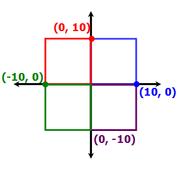
If all coordinates of the vertices must be integers, we might immediately see that these 4 squares all meet the given conditions:
Image


Any others?
You bet.
At this point, we're looking for something called Pythagorean Triplets. These are sets of three INTEGER values that could be the 3 sides of a right triangle.
The two most common ones to remember for the GMAT are 3-4-5 and 5-12-13.
We should also look out for MULTIPLES of these, such as 6-8-10 and 50-120-130
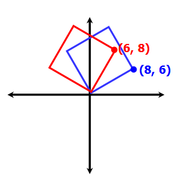
For this question, the 6-8-10 triplet comes into play. So, the hypotenuse (with length 10) will be one side of the square and the 6 and 8 will be the coordinated of the vertex.
Here are 2 such squares in Quadrant I:
Image

As you might guess, there will be 2 of these types of squares possible in each of the 4 quadrants for a total of 8 squares.

So, the TOTAL number of squares = 4 + 8 = 12

Cheers,
Brent
Brent Hanneson - Creator of GMATPrepNow.com
Image