BTGmoderatorLU wrote:Source: Magoosh
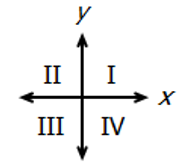
If jk ≠0 and (j, k) lies in the xy-coordinate system, in which quadrant does (j, k) lie?
1) jk < 0
2) j + k > 0
$$j,k\,\, \ne 0$$
$$?\,\,\,:\,\,\,\left( {j,k} \right){\rm{quadrant}}\,\,\,\,\,\,\,\, \Leftrightarrow \,\,\,\,\,\,?\,\,\,:\,\,\,j,k\,\,\,{\rm{signs}}$$
$$\left( {1 + 2} \right)\,\,\,\left\{ \matrix{
\,jk < 0 \hfill \cr
\,j + k > 0 \hfill \cr} \right.\,\,\,\,\,\,\,\,::\,\,\,\,\,\,\,\,\left\{ \matrix{
\,{\rm{Take}}\,\,\left( {j,k} \right) = \left( {2, - 1} \right)\,\,\,\,\,\left[ {{\rm{quadrant}}\,\,{\rm{IV}}} \right] \hfill \cr
\,{\rm{Take}}\,\,\left( {j,k} \right) = \left( { - 1,2} \right)\,\,\,\,\,\left[ {{\rm{quadrant}}\,\,{\rm{II}}} \right] \hfill \cr} \right.$$
The correct answer is therefore (E).
We follow the notations and rationale taught in the GMATH method.
Regards,
Fabio.






















