Joseph_Alexander wrote:GMATGuruNY wrote:Let's start with the most unusual shape, the pentagon inside the star. For any polygon with n sides, the sum of the interior angles = (n-2)*180. Thus, the sum of the angles inside the pentagon = (5-2)*180 = 540. There are 5 angles inside the pentagon. To make the math easy, let's plug in 540/5 = 108 for each interior angle.
Hi Mitch!
Here we are deriving 108 as the interior angle as a regular pentagon. In GMAT quant, we can't assume that the figures are drawn to scale unless the question specifically mentions it. So how can we assume that each of those angles are 108 degrees.
Am I missing something here? Please assist.
We can plug in ANY COMBINATION OF ANGLES that satisfies the following constraints:
1. Angles inside the pentagon must have a sum of 540
2. Angles that form a straight line must have a sum of 180
3. Angles inside a triangle must have a sum of 180
In my solution above, I made the angles inside the pentagon equal:
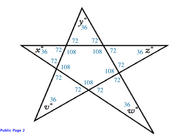
In this case, v+w+x+y+z = 36+36+36+36+36 = 180.
But the angles inside the pentagon can be ANY COMBINATION THAT HAS A SUM OF 540:
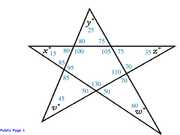
In this case, v+w+x+y+z = 45+60+15+25+35 = 180.
The same answer -- 180 -- is yielded in each case.
The reason is that each case satisfies all of the constraints in the problem.
Private tutor exclusively for the GMAT and GRE, with over 20 years of experience.
Followed here and elsewhere by over 1900 test-takers.
I have worked with students based in the US, Australia, Taiwan, China, Tajikistan, Kuwait, Saudi Arabia -- a long list of countries.
My students have been admitted to HBS, CBS, Tuck, Yale, Stern, Fuqua -- a long list of top programs.
As a tutor, I don't simply teach you how I would approach problems.
I unlock the best way for YOU to solve problems.
For more information, please email me (Mitch Hunt) at
[email protected].
Student Review #1
Student Review #2
Student Review #3























