BREAKING: Target Test Prep releases Brand New 2026 On Demand GMAT prep course

Redeem

GMAT PREP 1

Expert replies
Source: — Data Sufficiency |

by [email protected] » Thu Oct 29, 2015 11:44 am
Hi didieravoaka,

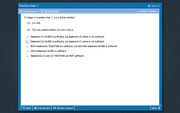
We're told that P is an INTEGER and that P > 1. We're asked if P is PRIME. This is a Yes/No question.

We can use a combination of TESTing VALUES and Number Properties to get to the correct answer.

1) P is ODD

IF....
P = 3
Then the answer to the question is YES.

IF...
P = 9
then the answer to the question is NO.
Fact 1 is INSUFFICIENT

2) The only positive factors of P are 1 and P

This Fact provides us with the actual definition of a Prime number. Prime numbers (2, 3, 5, 7, 11, 13, etc.) have JUST 2 factors - 1 and themselves. So when we're told that the only factors of P are 1 and P, then that means that P MUST be prime. The answer to the question is ALWAYS YES.
Fact 2 is SUFFICIENT.

Final Answer: B

GMAT assassins aren't born, they're made,
Rich

Contact Rich at [email protected]
Image
Join the discussion

by didieravoaka » Thu Oct 29, 2015 12:12 pm
Thanks Rich,

It makes more sense to me now.

Marc.
Join the discussion

by Matt@VeritasPrep » Fri Oct 30, 2015 12:16 am
They're annoying, but literal definitions are really useful on the GMAT. If we remember the literal definition of a prime ("a positive integer that has exactly two factors: 1, and itself"), we can see that S2 simply states this definition, forcing p to be prime.
Join the discussion

by Max@Math Revolution » Wed Nov 04, 2015 9:58 am
Forget conventional ways of solving math questions. In DS, Variable approach is the easiest and quickest way to find the answer without actually solving the problem. Remember equal number of variables and independent equations ensures a solution.

If integer p is greater than 1, is p a prime number?
1) p is odd
2) The only positive factors of p are 1 and p

There is one variable (p) and 2 equations are given from the 2 conditions, making (D) our likely answer.
From condition 1, the answer is 'yes' for p=3, but 'no' for p=9, so this is insufficient.
For condition 2, it is sufficient as it is the definition for a prime number. The answer is (B).

For cases where we need 1 more equation, such as original conditions with "1 variable", or "2 variables and 1 equation", or "3 variables and 2 equations", we have 1 equation each in both 1) and 2). Therefore, there is 59 % chance that D is the answer, while A or B has 38% chance and C or E has 3% chance. Since D is most likely to be the answer using 1) and 2) separately according to DS definition. Obviously there may be cases where the answer is A, B, C or E.
Join the discussion