PS Geometry

This topic has expert replies
Source: — Problem Solving |

User avatar
GMAT Instructor
Posts: 15539
Joined: Tue May 25, 2010 12:04 pm
Location: New York, NY
Thanked: 13060 times
Followed by:1906 members
GMAT Score:790

by GMATGuruNY » Mon Oct 06, 2014 8:05 am
Image

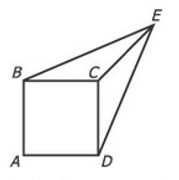
In the figure, each side of square ABCD has length 1, the length of line Segment CE is 1, and the length of line segment BE is equal to the length of line segment DE. What is the area of the triangular region BCE?
Image

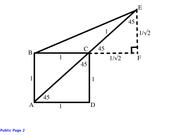
∆ECF:
Since AB || CF, ∠ECF = 45 degrees.
Thus, is a ∆ECF is a 45-45-90 triangle.
In a 45-45-90 triangle, the sides are in the following ratio:
x : x : x√2.
Since it is given the CE=1, EF = 1/√2 = (1*√2)/(√2*√2) = √2/2.

∆BCE:
If we consider BC the base, then EF is the corresponding height.
Thus, the area of ∆BCE = (1/2)(b)(h) = (1/2)(1)(√2/2) = √2/4.

The correct answer is B.
Private tutor exclusively for the GMAT and GRE, with over 20 years of experience.
Followed here and elsewhere by over 1900 test-takers.
I have worked with students based in the US, Australia, Taiwan, China, Tajikistan, Kuwait, Saudi Arabia -- a long list of countries.
My students have been admitted to HBS, CBS, Tuck, Yale, Stern, Fuqua -- a long list of top programs.

As a tutor, I don't simply teach you how I would approach problems.
I unlock the best way for YOU to solve problems.

For more information, please email me (Mitch Hunt) at [email protected].
Student Review #1
Student Review #2
Student Review #3

User avatar
Master | Next Rank: 500 Posts
Posts: 269
Joined: Sun Apr 27, 2014 10:33 pm
Thanked: 8 times
Followed by:5 members

by prachi18oct » Mon Oct 06, 2014 9:24 am
Hi GMATGuruNY,
∆ECF:
Since AB || CF, ∠ECF = 45 degrees.
Thus, is a ∆ECF is a 45-45-90 triangle.
How can we assume that CE will overlap with the diagonal of the square extended ? an you please explain how we can take that angle 45 ?
Can the figure not be a 3D figure also?

User avatar
GMAT Instructor
Posts: 15539
Joined: Tue May 25, 2010 12:04 pm
Location: New York, NY
Thanked: 13060 times
Followed by:1906 members
GMAT Score:790

by GMATGuruNY » Mon Oct 06, 2014 10:31 am
prachi18oct wrote:Hi GMATGuruNY,
∆ECF:
Since AB || CF, ∠ECF = 45 degrees.
Thus, is a ∆ECF is a 45-45-90 triangle.
How can we assume that CE will overlap with the diagonal of the square extended ? an you please explain how we can take that angle 45 ?
Can the figure not be a 3D figure also?
On page 20 of the OG13, the instructions for the Problem Solving section read as follows:
Figures are drawn as accurately as possible.
All figures lie in a plane unless otherwise indicated.


In my solution above, I was able to discern from the figure given in the question prompt that CE could be extended to vertex A, yielding diagonal AC.
That said, here is a proof:

Image

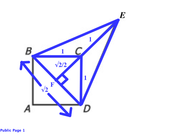
Comparing triangles BCE and ECD, we get:
BE = DE (as stated in the problem).
BC = CD = 1.
Both triangles share side CE.
Since all corresponding sides are equal, ∆BCE and ∆ECD are CONGRUENT.

In congruent triangles, corresponding angles are EQUAL.
Thus, as shown in the figure above, ∠BCE = ∠ECD = 135.

Since ∠BCE = 135, we get the figure shown in my initial post:
Image
Last edited by GMATGuruNY on Mon Oct 06, 2014 10:46 am, edited 1 time in total.
Private tutor exclusively for the GMAT and GRE, with over 20 years of experience.
Followed here and elsewhere by over 1900 test-takers.
I have worked with students based in the US, Australia, Taiwan, China, Tajikistan, Kuwait, Saudi Arabia -- a long list of countries.
My students have been admitted to HBS, CBS, Tuck, Yale, Stern, Fuqua -- a long list of top programs.

As a tutor, I don't simply teach you how I would approach problems.
I unlock the best way for YOU to solve problems.

For more information, please email me (Mitch Hunt) at [email protected].
Student Review #1
Student Review #2
Student Review #3

User avatar
GMAT Instructor
Posts: 15539
Joined: Tue May 25, 2010 12:04 pm
Location: New York, NY
Thanked: 13060 times
Followed by:1906 members
GMAT Score:790

by GMATGuruNY » Mon Oct 06, 2014 10:37 am
Alternate approach:

Image

In square ABCD, since s=1, BD = √2 and CF = √2/2.
It is given that CE=1.
Thus, EF = √2/2 + 1.

∆BED = (1/2)(BD)(EF) = (1/2)(√2)(√2/2 + 1) = (1/2)(1 + √2) = 1/2 + √2/2.

∆BCD = (1/2)(square ABCD) = 1/2.

Quadrilateral BEDC = ∆BED - ∆BCD = (1/2 + √2/2) - 1/2 = √2/2.

∆BCE = (1/2)(quadrilateral BEDC) = (1/2)(√2/2) = √2/4.

The correct answer is B.
Private tutor exclusively for the GMAT and GRE, with over 20 years of experience.
Followed here and elsewhere by over 1900 test-takers.
I have worked with students based in the US, Australia, Taiwan, China, Tajikistan, Kuwait, Saudi Arabia -- a long list of countries.
My students have been admitted to HBS, CBS, Tuck, Yale, Stern, Fuqua -- a long list of top programs.

As a tutor, I don't simply teach you how I would approach problems.
I unlock the best way for YOU to solve problems.

For more information, please email me (Mitch Hunt) at [email protected].
Student Review #1
Student Review #2
Student Review #3