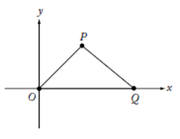
To get the area of this triangle, let's define the base and the height:
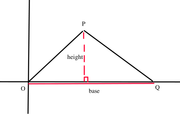
The base of the triangle goes from the origin to point Q on the x axis. Thus, the length of that
base will be the x-coordinate of point Q.
The height of the triangle will be the height of P. It doesn't really matter where P falls horizontally along the x-axis. The only thing that matters is vertical distance: the
height = the y-coordinate of P.
Since area = (1/2)b*h, we're wondering if (1/2)(the x-coord of Q)(the y-coord of P) > 48. Or we can multiply both sides by 2:
Rephrased question: (the x-coord of Q)(the y-coord of P) > 96 ?
Let's look at the statements:
(1) The coordinates of point P are (6, 8).
At first, it doesn't look like this will tell us about the entire triangle, since it doesn't give us information about Q. However, it does tell us the area of part of the triangle:
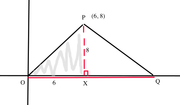
We can create a right triangle with side lengths of 6 and 8, so an area of (1/2)(6)(8) = 24.
What about the other side of the triangle? We're given that OP < PQ. Since we know that the side lengths of our smaller triangle are 6 and 8, we can conclude that OP = 10. Thus, PQ must be greater than 10:
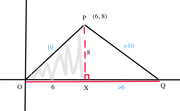
If that hypotenuse is greater than 10, and one side is 8, the other side must be greater than 6.
Thus, the area of the other triangle must be greater than 24, and the overall triangle must have an area greater than 48.
Sufficient.
(2) The coordinates of point Q are (13, 0).
This tells us the length of the base. However, we could imagine a variety of different y-coordinates for P:
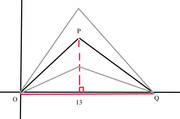
These would all give different areas.
Since we can't make any inferences about the height from (2), this is insufficient.
The answer is
A.
Ceilidh Erickson
EdM in Mind, Brain, and Education
Harvard Graduate School of Education