BREAKING: Target Test Prep releases Brand New 2026 On Demand GMAT prep course

Redeem

Target Test Prep · GMAT

Choose how you want to prepare

Learn live with an expert or move at your own pace. Every option includes the complete TTP study system.

★★★★★5.0559 reviews
GMATLiveTeach 7 seats left
Chris Peckover
NEXT LIVE COHORT

Oct 13 to Jan 7, 2027

with Chris Peckover

Schedule
Tue, Thu · 8:00 to 10:00 PM ET
Included
40 live hours + 6 months of GMAT OnDemand
  • Live instruction and real-time questions
  • Class recordings and assigned practice
View class & enroll
Limited cohort · enrollment openTarget Test Prep

EALiveTeach 5 seats left
Logan Thompson
EXECUTIVE ASSESSMENT

Sep 6 to Dec 6, 2026

with Logan Thompson

Schedule
Sun · 9:30 AM to 12:30 PM ET
Included
40 hours of live online classes plus six months of access to the complete TTP EA OnDemand course.
  • 165+ EA Score Guarantee
  • 4,100+ Quant, Verbal, and Integrated Reasoning practice questions
  • 400+ hours of in-depth video lessons
  • 3,000+ step-by-step video solutions
View EA class & enroll
Limited cohort · enrollment openTarget Test Prep
GMATOnDemand Start anytime
SELF-PACED MASTERCLASS

Target Test Prep GMAT OnDemand

Complete access from day one. Study on your schedule.

715+ score guarantee
$0to start then $127/mo
  • Personalized study plan and analytics
  • Thousands of lessons and practice questions

Compare the format, schedule, and included access before enrolling. Prices and seat counts shown reflect the supplied offer details.

OG16 - DS 67

Expert replies
Source: — Data Sufficiency |

by DavidG@VeritasPrep » Mon May 23, 2016 10:27 am
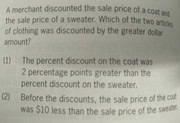
A merchant discounted the sale price of a coat and the sale price of a sweater. Which of
the two articles of clothing was discounted by the greater dollar amount?

(1) The percent discount on the coat was 2 percentage points greater than the
percent discount on the sweater.

(2) Before the discounts, the sale price of the coat was $10 less than the sale price of
the sweater.
Each statement alone can be dismissed quickly. Statement 1 tells us nothing about about the pre-discount prices of the items. Statement 2 tells us nothing about the magnitude of the discounts.

Together: Pick some easy numbers. Case 1: Initial cost of coat = 10; Discount on coat = 10%; Dollar discount = 10 * .1 = $1
initial cost of sweater = 20. Discount on sweater = 8%. Dollar discount = 20* .08 = $1.60. Sweater has larger discount

Case 2: Initial cost of coat = 90; Discount on coat = 10%; Dollar discount = 90 * .1 = $9
initial cost of sweater = 100. Discount on sweater = 8%. Dollar discount = 100* .08 = $8. Coat has larger discount.

Using the statements together, we still cannot definitively answer the question. Answer is E
Veritas Prep | GMAT Instructor

Veritas Prep Reviews
Save $100 off any live Veritas Prep GMAT Course
Join the discussion

by OptimusPrep » Thu May 26, 2016 7:14 pm
amina.shaikh309 wrote:Image
Given: Merchant discounted the price of a coat and a sweater
Required: Which article was discounted by a greater amount?

Statement 1: Percentage discount on coat was 2 percent greater than that on sweater.
We cannot comment about the total amount of discount as it will depend on the Selling Price.
INSUFFICIENT

Statement 2: Difference in Selling price before discount = 10
We do not know anything about the discount percent.
INSUFFICIENT

Combining both Statements:
Difference in Selling Price = 10
Difference in percentage discount = 2%
Since we do not know the exact percentage discount, we cannot tell the exact amount
INSUFFICIENT

Correct Option: E
Join the discussion

by Matt@VeritasPrep » Fri May 27, 2016 2:28 pm
We could use algebra here.

Suppose that prediscount the coat = c and the sweater = s.

S1:

The coat is discounted by p, the sweater is discounted by (p - 2). This doesn't give us any dollar amounts; NOT SUFFICIENT.

S2:

c = s - 10. This doesn't give us the discounts; NOT SUFFICIENT.

Together, we've got

coat discount: c * p
sweat discount: (c + 10) * (p - 2)

We want to know whether

cp > (c + 10) * (p - 2)

or

cp > cp + 10p - 2c - 20

c > 5p - 10

But we don't know c or p, so we can't answer the question.
Join the discussion