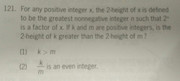
For any positive integer x, the 2-height of x is defined to be the greatest non-negative integer n such that 2^n is a factor of x. If k and m are positive integers, is the 2-height of k greater than the 2-height of m?
1) k>m
2) k/m is an even integer
We can think of the 2-height of x is being the greatest n when x/(2^n) = integer. So another way to think of this is that the 2-height of x is the number of 2's that x contains in its prime factorization. For example, the 2-height of 16 would simply be 4, as 16 = 2^
4. The 2 height of 12 would be 2 as 12 = 2^
2*3.
Statement 1: Pick some numbers. Case 1: k = 6 and m = 4.
The 2-height of k is 1 as 6 = 2 * 3
The 2-height of m is 2 as 4 = 2^2.
We get a NO, the 2-height of k is not greater than the 2-height of m
Case 2: k = 8
m = 4
The 2-height of k is 3 as 8 = 2^3
The 2-height of m is 2 as 4= 2^2
We get a YES, the 2-height of k is greater than the 2-height of m.
Because we can get a YES and a NO, statement 1 is not sufficient.
Statement 2:
If k/m is an even integer, then we can reuse k = 8 and m = 4, as 8/4 = 2. So we know we can get a YES.
Or try k = 32 and m = 8.
2-height of k is 5, as 32 = 2^5
2-height of m is 3, as 8 = 2^3
Another YES
You'll see quickly that no matter what you pick, you'll get a YES. So statement 2 is sufficient and the answer is
B
(In essence, we're trying to determine which number has more 2's. If k/m is EVEN, we can say that k/m = 2*integer. Or k = m*2*integer.
No matter what you pick for m, you're multiplying that number by 2, so k will always contain more 2's.)