[email protected] wrote: ↑Fri Aug 02, 2013 8:16 am
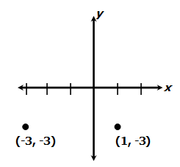
In the xy coordinate plane, is point R equidistant from points (-3,-3) and (1,-3)?
1) The x coordinate of point R is -1
2) Point R lies on the line y= -3
Solution:
Question Stem Analysis:
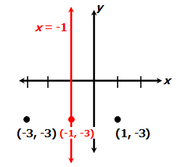
We need to determine whether point R is equidistant from points (-3,-3) and (1,-3), If it is, then it must be on the perpendicular bisector of the segment connecting (-3,-3) and (1,-3). Since the segment connecting (-3,-3) and (1,-3) is horizontal, the perpendicular bisector of the segment must be vertical, passing through the midpoint of the segment. Since the midpoint of the segment is (-1, -3), the equation of the perpendicular bisector is x = -1. That is, if R is any point on the line x = -1, then it’s equidistant from points (-3,-3) and (1,-3).
Statement One Alone:
Since the x-coordinate of point R is -1, R must be a point on the line x = -1. Therefore, it is equidistant from points (-3,-3) and (1,-3). Statement one alone is sufficient.
Statement Two Alone:
We see that R is a point on the line containing the segment connecting (-3,-3) and (1,-3). However, we can’t determine whether it is equidistant from points (-3,-3) and (1,-3). For example, if R = (-1, -3), i.e., the midpoint of (-3,-3) and (1,-3), then it is equidistant from points (-3,-3) and (1,-3). Otherwise, it is not. Statement two alone is not sufficient.
Answer: A