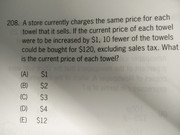
A store currently charges the same price for each towel that it sells. If the current price of each towel were to be increased by $1, 10 fewer of the towels could be bought for $120, excluding sales tax. What is the current price of each towel?
(A) $1
(B) $2
(C) $3
(D) $4
(E) $12
We can PLUG IN THE ANSWERS, which represent the current price.
When the correct answer choice is plugged in, increasing the price by $1 will allow for the purchase of 10 fewer towels.
Answer choice D: 4
At $4 per towel, the number of towels that can be purchased for $120 = 120/4 = 30.
If the price is increased by $1 to $5 per towel, the number of towels that can be purchased for $120 = 120/5 = 24.
Decrease in the number of towels that can be purchased = 30-24 = 6.
Here, the decrease is too small.
Eliminate D.
Answer choice B: $2
At $2 per towel, the number of towels that can be purchased for $120 = 120/2 = 60.
If the price is increased by $1 to $3 per towel, the number of towels that can be purchased for $120 = 120/3 = 40.
Decrease in the number of towels that can be purchased = 60-40 = 20.
Here, the decrease is too great.
Eliminate B.
Since D yields a decrease that is TOO SMALL, and B yields a decrease that is TOO GREAT, the correct answer must be BETWEEN B AND D.
The correct answer is
C.
Answer choice C: $3
At $3 per towel, the number of towels that can be purchased for $120 = 120/3 = 40.
If the price is increased by $1 to $4 per towel, the number of towels that can be purchased for $120 = 120/4 = 30.
Decrease in the number of towels that can be purchased = 40-30 = 10.
Success!
Private tutor exclusively for the GMAT and GRE, with over 20 years of experience.
Followed here and elsewhere by over 1900 test-takers.
I have worked with students based in the US, Australia, Taiwan, China, Tajikistan, Kuwait, Saudi Arabia -- a long list of countries.
My students have been admitted to HBS, CBS, Tuck, Yale, Stern, Fuqua -- a long list of top programs.
As a tutor, I don't simply teach you how I would approach problems.
I unlock the best way for YOU to solve problems.
For more information, please email me (Mitch Hunt) at
[email protected].
Student Review #1
Student Review #2
Student Review #3