BREAKING: Target Test Prep releases Brand New 2026 On Demand GMAT prep course

Redeem

Fractions

Expert replies
by abhirup1711 » Thu Jun 13, 2013 5:55 am

Timer

00:00

Answers

A

B

C

D

E

Stats

Difficulty

3/20 members of a social club are retirees who are bridge players, 7/20 members are retirees, and one half of the members are bridge players. If 120 of the members are neither retirees nor bridge players,what is the total number of members in the social club?

240
300
360
400
480

Please help
Join the discussion
Source: — Problem Solving |

Fractions

by GMATGuruNY » Thu Jun 13, 2013 7:46 am
abhirup1711 wrote:3/20 members of a social club are retirees who are bridge players, 7/20 members are retirees, and one half of the members are bridge players. If 120 of the members are neither retirees nor bridge players,what is the total number of members in the social club?

240
300
360
400
480

Please help
This is an EITHER/OR problem.
Every member EITHER plays bridge OR doesn't.
Every member EITHER is a retiree or OR isn't.

Since the fractions in the problem are 3/20 and 7/20, let the total number of members = 20x.
To organize the data, draw a GROUP GRID:
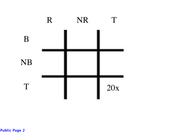
Image
In the grid above, B = bridge, NB = no bridge, R = retiree, NR = not a retiree.

3/20 members are retirees who are bridge players:
RB = (3/20)20x = 3x.
7/20 of the members are retirees:
R = (7/20)20x = 7x.
One half of the members are bridge players:
B = (1/2)(20x) = 10x.
Enter these values into the grid:
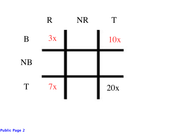
Image

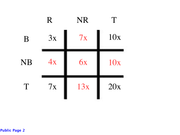
Complete the grid:
Image

The grid indicates that the number of members who are neither retirees nor bridge players is equal to 6x.
Since 120 members are neither retirees nor bridge players, we get:
6x = 120
x = 20.

Thus:
Total members = 20x = 20*20 = 400.

The correct answer is D.
Private tutor exclusively for the GMAT and GRE, with over 20 years of experience.
Followed here and elsewhere by over 1900 test-takers.
I have worked with students based in the US, Australia, Taiwan, China, Tajikistan, Kuwait, Saudi Arabia -- a long list of countries.
My students have been admitted to HBS, CBS, Tuck, Yale, Stern, Fuqua -- a long list of top programs.

As a tutor, I don't simply teach you how I would approach problems.
I unlock the best way for YOU to solve problems.

For more information, please email me (Mitch Hunt) at [email protected].
Student Review #1
Student Review #2
Student Review #3
Join the discussion

by Atekihcan » Fri Jun 14, 2013 5:12 am
Total = Retirees + Players - Both + None

Say, total = N
So, retirees = 7N/20, players = N/2 = 10N/20, and both = 3N/20

So, None = total - (retirees + players - both)
So, None = N - (7N/20 + 10N/20 - 3N/20) = N - 14N/20 = 6N/20 = 3N/10

So, 3N/10 = 120
So, N = 120*10/3 = 400

Answer : D
Join the discussion

by Brent@GMATPrepNow » Fri Jun 14, 2013 5:21 am
I thought I'd point out that Mitch's "group grid" approach is also known as the Double Matrix Method. This technique can be used for most questions featuring a population in which each member has two characteristics associated with it.
Here, we have a population of social club members, and the two characteristics are:
- retirees or not retirees
- bridge players or not bridge players

To learn more about this technique, watch our free video: https://www.gmatprepnow.com/module/gmat- ... ems?id=919

Then try these additional practice questions that can be solved using the Double Matrix Method:
- https://www.beatthegmat.com/mba/2011/05/ ... question-1
- https://www.beatthegmat.com/mba/2011/05/ ... question-2
- https://www.beatthegmat.com/mba/2011/05/ ... question-3
- https://www.beatthegmat.com/ds-quest-t187706.html
- https://www.beatthegmat.com/overlapping- ... 83320.html
- https://www.beatthegmat.com/finance-majo ... 67425.html
- https://www.beatthegmat.com/ds-french-ja ... 22297.html

Cheers,
Brent
Brent Hanneson - Creator of GMATPrepNow.com
Image
Join the discussion

Fractions

by jain2016 » Sun Feb 07, 2016 9:02 am

Since the fractions in the problem are 3/20 and 7/20, let the total number of members = 20x.
To organize the data, draw a GROUP GRID:
Image
In the grid above, B = bridge, NB = no bridge, R = retiree, NR = not a retiree.

3/20 members are retirees who are bridge players:
RB = (3/20)20x = 3x.
7/20 of the members are retirees:
R = (7/20)20x = 7x.
One half of the members are bridge players:
B = (1/2)(20x) = 10x.

Hi Mitch ,

One question.

R= (7/20)20x = 7x understood

It is given that 3/20 members of a social club are retirees who are bridge players , so now we have a R , which is 7x right.

So why not RB = (3/20)7x ?

Please explain and correct me.

Many thanks in advance.

SJ
Join the discussion

by [email protected] » Sun Feb 07, 2016 9:51 am
Hi SJ,

When dealing with Overlapping Sets questions, you have to pay careful attention to language (so that you're putting the proper 'data' in the proper 'spot').

Here, we're told that 3/20 OF MEMBERS in a club are retirees AND bridge players, so that would be (3/20)(20X).

IF.... the prompt had stated 3/20 OF RETIREES are bridge players, then the calculation would be (3/20)(7X).

GMAT assassins aren't born, they're made
Rich
Contact Rich at [email protected]
Image
Join the discussion