BREAKING: Target Test Prep releases Brand New 2026 On Demand GMAT prep course

Redeem

ABC's and 123's

Expert replies
by pchun008 » Mon May 05, 2014 8:34 pm
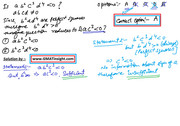
If abcd ≠ 0, is ab2c3d4 < 0?

(1) ab2c3 < 0

(2) b2c3d4 < 0

I encountered this problem on an MGMAT CAT exam, but the explanation makes no sense to me. The official answer is A. Can anyone explain why the answer is A?
Join the discussion
Source: — Data Sufficiency |

by [email protected] » Mon May 05, 2014 11:37 pm
Hi pchun008,

I assume that this question involves exponent rules. For future reference, when posting these types of questions, you should use the following notation:

When referring to X-squared, write X^2
When referring to Y-cubed, write Y^3
Etc.

Here, were told that abcd is not equal to 0, so NONE of the variables can be 0.

We're asked if A(B^2)(C^3)(D^4) < 0? This is a YES/NO question.

Since we're not allowed to use 0, we already know that (B^2) is going to be positive and (D^4) is also going to be positive.

This question is ultimately asking "Is A(C^3) < 0?"

This question can further be "re-written" as "Is one of A or C negative?" although you might not need to take this question that far.

Fact 1: A(B^2)(C^3) < 0

Since (B^2) = positive, this Fact tells us that A(C^3) < 0, so the answer to the question is ALWAYS YES.
Fact 1 is SUFFICIENT

Fact 2: (B^2)(C^3)(D^4) < 0

Since (B^2) is positive and (D^4) is positive, this Fact tells us that (C^3) < 0.

However, it does not tell us anything about the value of A.
If A = negative, then the answer to the question is NO.
If A = positive, then the answer to the question is YES.
Fact 2 is INSUFFICIENT

Final Answer: A

GMAT assassins aren't born, they're made,
Rich
Contact Rich at [email protected]
Image
Join the discussion

by pchun008 » Tue May 06, 2014 9:17 am
Thanks! That makes so much more sense to me. The book explanation was really confusing, which is the reason why I thought it would be best to post here and hopefully get a better and more easily digestible explanation.

I apologize about the formatting, I'll remember to heed that next time! :)
Join the discussion

by Matt@VeritasPrep » Mon May 12, 2014 12:15 pm
As an addendum here, a much better way of writing exponents is using ASCII codes to write them properly, or just copying them in exponent form from this page:

https://stackoverflow.com/questions/1509 ... r-power-10

Then an equation such as

a * b² * c³ * d� < 0

is much easier to read and follow.
Join the discussion

by GMATinsight » Tue May 13, 2014 8:50 am
Image
"GMATinsight"Bhoopendra Singh & Sushma Jha
Most Comprehensive and Affordable Video Course 2000+ CONCEPT Videos and Video Solutions
Whatsapp/Mobile: +91-9999687183 l [email protected]
Contact for One-on-One FREE ONLINE DEMO Class Call/e-mail
Most Efficient and affordable One-On-One Private tutoring fee - US$40-50 per hour
Join the discussion

by unknown13 » Thu May 15, 2014 7:37 pm
thanks for the explanation
but suppose the question is

If abcd ≠ 0, is abcd < 0?

(1) abc < 0

(2) bcd < 0

Do you think the answer will be E
Join the discussion

by confused13 » Thu May 15, 2014 11:22 pm
I say the answer is D. Why ?

The only options left are TOGETHER or NEITHER.

Together:
b,c must have the same values in both (1) and (2)

b=1
c=-1

-> d=-1
-> a=-1
-> abcd<0

if
b=-1
c=-1

-> d=-1
-> a=-1

-> abcd>0


--> D


But I'd love to hear Rich's explanation. His explanations are always good.
Join the discussion

by [email protected] » Thu May 15, 2014 11:55 pm
Hi confused13,

If we deal with the question that unknown13 posed....then we can use Number Properties to solve it.

We're told that none of the variables can = 0. We're asked Is ABCD < 0? This is a YES/NO question.

Fact 1: ABC < 0

We're not told anything about D.
If D = Positive, then ABCD < 0 and the answer to the question is YES.
if D = Negative, then ABCD > 0 and the answer to the question is NO.
Fact 1 is INSUFFICIENT.

Fact 2: BCD < 0

This is similar to what we saw in Fact 1.
We don't know anything about A.
If A = Positive, then ABCD < 0 and the answer to the question is YES.
If A = Negative, then ABCD > 0 and the answer to the question is NO.
Fact 2 is INSUFFICIENT.

Combined, we know....
Since ABC < 0, then 1 or ALL 3 of the variables are NEGATIVE
Since BCD < 0, then 1 or ALL 3 of the variables are NEGATIVE
Notice how B and C appear in BOTH inequalities....

IF....
C = Negative
A = Positive
B = Positive
D = Positive
Then the answer to the question is YES.

IF....
A = Negative
B = Positive
C = Positive
D = Negative
Then the answer to the question is NO.

Final Answer: E

GMAT assassins aren't born, they're made,
Rich

Contact Rich at [email protected]
Image
Join the discussion