buoyant wrote:After 2/9 of the numbers in a data set A were observed, it turned out that 3/4 of those numbers were non-negative. What fraction of the remaining numbers in set A must be negative so that the total ratio of negative numbers to non-negative numbers is 2 to 1?
a)11/14
b)13/18
c)4/7
d)3/7
e)3/14
[spoiler]OA:A[/spoiler]
This is an EITHER/OR group problem.
Every number is a member of EITHER the first group of numbers OR the remaining numbers.
Every number is EITHER negative OR non-negative.
For an EITHER/OR group problem, use a GROUP GRID (also known as a double-matrix) to organize the data.
Let F = first group, R = remaining, N = negative, NN = non-negative.
Let the total number of numbers in set A = the LCM of the denominators in the problem = 9*4 = 36.
Here is the grid:
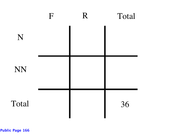
In a group grid, the entries in any given row or column must sum to the TOTAL of that row or column.
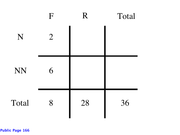
After 2/9 of the numbers in a data set A were observed, it turned out that 3/4 of those numbers were non-negative.
Thus:
Total F = (2/9)(36) = 8.
Non-negative in F = (3/4)(8) = 6.
The following grid is yielded:
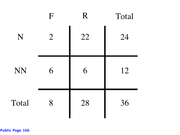
 The total ratio of negative numbers to non-negative numbers is 2 to 1.
Since 2 of every 3 numbers in set A must be negative, we get:
Total N = (2/3)(36) = 24.
Total NN = 36-24 = 12.
The following grid is yielded:
 What fraction of the remaining numbers in set A must be negative?
In the resulting grid:
(negative numbers in R)/(total R) = 22/28 = 11/14.
The correct answer is
A.
Private tutor exclusively for the GMAT and GRE, with over 20 years of experience.
Followed here and elsewhere by over 1900 test-takers.
I have worked with students based in the US, Australia, Taiwan, China, Tajikistan, Kuwait, Saudi Arabia -- a long list of countries.
My students have been admitted to HBS, CBS, Tuck, Yale, Stern, Fuqua -- a long list of top programs.
As a tutor, I don't simply teach you how I would approach problems.
I unlock the best way for YOU to solve problems.
For more information, please email me (Mitch Hunt) at
[email protected].
Student Review #1
Student Review #2
Student Review #3


























