Priyaranjan wrote:Q. A certain characteristic in a large population has a distribution that is symmetric about the mean (m). If 68% of the distribution lies within one standard deviation (d) of the mean, what percent of the distribution is less than m+d?
A) 16%
B) 32%
C) 48%
D) 84%
E) 92%
Solution:
This problem is testing us on the Empirical rule.
In all normal distributions, the Empirical Rule tells us that:
1. About 68 percent of all data values will fall within 1 standard deviation of the mean.
2. About 95 percent of all data values will fall within 2 standard deviations of the mean.
3. About 99.7 percent of all data values will fall within 3 standard deviations of the mean.
It's important to note that, for example, one standard deviation within the mean refers to the data that exists from one standard deviation below the mean to one standard deviation above the mean. Similarly, two standard deviations within the mean refers to the data that exist from two standard deviations below the mean to two standard deviations above the mean.
This is a sketch of a representative normal curve, with the Empirical Rule displayed. The red area indicates the entire part of the curve that is less than (m+d) standard deviations above the mean.
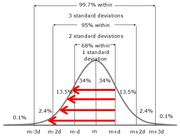
In this particular problem we are being asked what percent of the distribution is less than m + d. We have denoted this on the diagram above. If we add all the percentages in the regions where the red arrows point, we have:
34% + 34% + 13.5% + 2.4 + 0.1 % = 84%
This represents the percent of the distribution that is less than m + d.
Another way to look at this problem is to first see that m is exactly in the middle of the curve; thus, 50% of the data points are below m and 50% are above m. From the Empirical Rule we know that 68% of the data points are within one standard deviation of the mean. This means that 68% of the distribution is between m - d and m + d. Furthermore this means that only 68%/2 = 34% of the distribution is between m and m + d.
We are asked what percent of the distribution is less than m + d (or less than one standard deviation above the mean). Since 50% of the data points are less than m, and 34% of the data points are between m and m + d, we see that 50% + 34% = 84% of the data points (that is, 84% of the distribution) is less than m + d.
The answer is
D




























