BREAKING: Target Test Prep releases Brand New 2026 On Demand GMAT prep course

Redeem

Concept

Expert replies
by [email protected] » Thu May 09, 2013 2:23 am
122. What is the volume of a certain rectangular solid?
(1) Two adjacent faces of the solid have areas 15
and 24, respectively.
(2) Each of two opposite faces of the solid has
area 40.
Join the discussion
Source: — Problem Solving |

by Atekihcan » Thu May 09, 2013 2:41 am
Edit: Deleted the post as I was denying one of the basic principle of solving DS problem - You cannot use one statement to disprove the other one. The both statements are always true whether they are sufficient or not, individually or together.
Last edited by Atekihcan on Thu May 09, 2013 7:05 am, edited 1 time in total.
Join the discussion

by Jim@StratusPrep » Thu May 09, 2013 6:26 am
This is an actual OG question though, so it is important to note that this wording can come up... Having a clear view of what the GMAT tests goes a long way to not getting caught up in irrelevant details...
GMAT Answers provides a world class adaptive learning platform.
-- Push button course navigation to simplify planning
-- Daily assignments to fit your exam timeline
-- Organized review that is tailored based on your abiility
-- 1,000s of unique GMAT questions
-- 100s of handwritten 'digital flip books' for OG questions
-- 100% Free Trial and less than $20 per month after.
-- Free GMAT Quantitative Review

Image
Join the discussion

by Brent@GMATPrepNow » Thu May 09, 2013 6:32 am
[email protected] wrote:What is the volume of a certain rectangular solid?
(1) Two adjacent faces of the solid have areas 15 and 24, respectively.
(2) Each of two opposite faces of the solid has area 40.
Target question: What is the volume of a certain rectangular solid (box)?

Statement 1: Two adjacent faces of the solid have areas 15 and 24, respectively.
There are several different rectangular solids that meet this condition. Here are two:
Case a: the dimensions are 1x15x24, in which case the volume is 360
Case b: the dimensions are 3x5x8, in which case the volume is 120
Since we cannot answer the target question with certainty, statement 1 is NOT SUFFICIENT

Statement 2: Each of two opposite faces of the solid has area 40.
Definitely not sufficient

Statements 1 and 2 combined:
So, we know the area of each face (noted in blue on the diagram below).
Let's let x equal the length of one side.
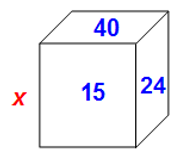
Image


Since the area of each face = (length)(width), we can express the other two dimensions in terms of x.
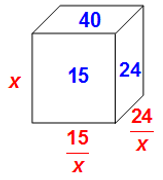
Image

From here, we'll focus on the face that has area 40.
This face has dimensions (15/x) by (24/x)
Since the area is 40, we know that (15/x)(24/x) = 40
Expand: 360/(x^2) = 40
Simplify: 360 = 40x^2
Simplify: 9 = x^2
Solve: x = 3 or -3
Since the side lengths must be positive, we can be certain that x = 3

When we plug x=3 into the other two dimensions, we get 15/3 and 24/3
So, the 3 dimensions are 3, 5, and 8, which means the volume of the rectangular solid must be 120.
Since we can answer the target question with certainty, the combined statements are SUFFICIENT

Answer = C

Cheers,
Brent
Brent Hanneson - Creator of GMATPrepNow.com
Image
Join the discussion

by Brent@GMATPrepNow » Thu May 09, 2013 6:35 am
Atekihcan wrote: First of all "rectangular solid" is a very vague term. It can be interpreted as some complex solid objects that are beyond the scope of GMAT.
"rectangular solid" is defined in the Official Guide (page 134 in the OG12 and OG13)
It's defined as what we know as a box

Cheers,
Brent

Brent Hanneson - Creator of GMATPrepNow.com
Image
Join the discussion

by Atekihcan » Thu May 09, 2013 7:07 am
Brent@GMATPrepNow wrote:"rectangular solid" is defined in the Official Guide (page 134 in the OG12 and OG13)
It's defined as what we know as a box
Thanks Brent.
I take back what I said.
I don't know what I was thinking when I made that post.
Join the discussion