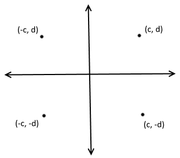
It might help you to visualize by drawing the vertices of the square.
Remember this rule on the GMAT:
you are given limitations on variables for a reason.
Why would they tell us that c < 0 and d > 0? It must matter somehow.
If c is always negative, then (c, d) will become (-c, d), since a positive number multiplied by a negative number is always negative. The "d" will not be affected, since a positive multiplied by a positive is always positive.
By the same line of thinking:
(c, -d) = (-c, -d)
(-c, -d) = (c, -d)
Let's plot (-c, d), (-c, -d), and (c, -d) on the coordinate grid, and it will be easy to see the missing quadrant.
The first quadrant, in which "c" and "d" are positive, is missing. Look for an answer choice with a positive value for both x and y. It must be [spoiler](E)[/spoiler].