3 Questions

This topic has expert replies
Source: — Data Sufficiency |

Senior | Next Rank: 100 Posts
Posts: 38
Joined: Thu Jun 19, 2008 4:54 am
Location: Pune, India

by microke » Thu Jul 17, 2008 3:41 am
For question no.1, statement 1 says,

q-p<50, maximum we can write this equation as q<50+1.06p (Considering the sales tax). But this statement alone will not give any sufficient information about q or p. Simply, there are two variables, in one single equation, which is insufficien tto answer.

Statement two gives information about only one variable,q. No knowledge about P.

But when we combine together we get one eqn, 1150< 50+ 1.06P, from which we can determine what is P and the question stem can be answered. So the correct answer is C

Senior | Next Rank: 100 Posts
Posts: 58
Joined: Fri Jul 11, 2008 5:00 am
Thanked: 4 times

by Canman » Thu Jul 17, 2008 4:42 am
I think question two addresses the following (prephrasing):

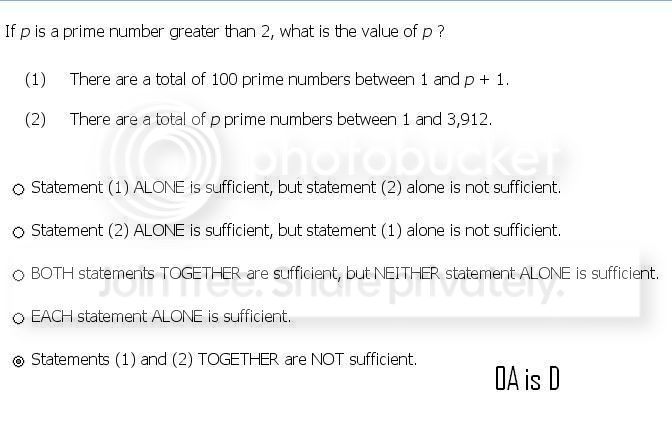
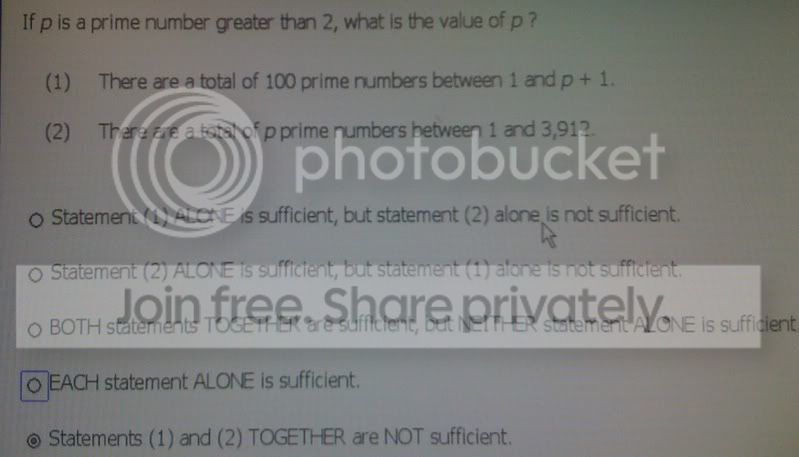
1) What is the 100th prime number? We can answer this- SUFFICIENT

2) How many prime numbers between 1 and 3912? (the answer itself is probably prime since p is defined as prime in the question stem) - SUFFICIENT

Ans D

Anyone have any other thoughts?

Senior | Next Rank: 100 Posts
Posts: 58
Joined: Fri Jul 11, 2008 5:00 am
Thanked: 4 times

by Canman » Thu Jul 17, 2008 4:42 am
I think question two addresses the following (prephrasing):

1) What is the 100th prime number? We can answer this- SUFFICIENT

2) How many prime numbers between 1 and 3912? (the answer itself is probably prime since p is defined as prime in the question stem) - SUFFICIENT

Ans D

Anyone have any other thoughts?


















