das.ashmita wrote:Cool Games Corporation derives all of its revenues through the sales of video games. Last year, it fell just short of making a profit although it had strong revenues of $200 million worldwide, half from children and half from adults. This year, the company's sales to children rose 20% to $120 million, but its sales to adults dropped 40% to a disappointing $60 million. One of the most renowned Wall Street analysts had forecasted that Cool Games Corporation would need to at least match its revenues of last year in order to have a chance to make a profit on video games this year. Upon hearing the news of the Cool Games Corporation's revenue, the analyst concluded that it was not possible for the company to have made a profit this year.
The analyst's conclusion is based on which of the following assumptions?
(A) The total cost and expenses of Cool Games Corporation did not decrease by more than the decrease in revenue for the corporation.
(B) Adults usually purchased the more complex and expensive games.
(C) Cool Game Corporation increased its marketing efforts to children this year.
(D) The average sales of all video game companies decreased significantly this year.
(E) Sales to adults are more profitable than sales to children.
OA A
Hi das.ashmita!
Let's hit this CR problem step-by-step (and I use a 4-step approach for all of them).
Step 1: Identify & Digest the Question
"The analyst's conclusion is based on which of the following assumptions?"
So we have a "Find the Assumption" problem. This means that we should read the argument with a SKEPTICAL view & the following thoughts in our mind:
- I'm not going to be overly fond of this argument
- BUT I might be willing to believe it with some additional information
- WHAT types of things do I think the author has failed to mention?
- WHAT do I think he needs to tell me in order for me to believe him??
Step 2: Deconstruct the Argument
Now we read and deconstruct. My notes looked something like the following:
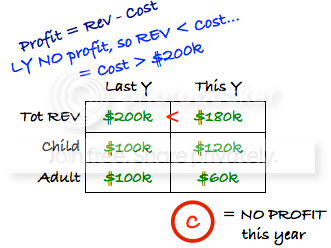
Now note, the important part of reading/deconstructing the argument is just to understand what in the world is going on. The analyst said that the company didn't make a profit last year which means Costs had to exceed Revenue (that is the profit equation). And sadly for Cool Games, their total Revenue went down this year (120+60=$180k) so how could they still make a profit??
Be a skeptic - try NOT to believe the analyst. What would you want to know in order to believe him...
- What happened with cost?
- if costs FELL, then it might be enough to offset the dropped Rev and Cool Games would be okay!
- if costs ROSE or stayed the same, then the analyst would be right, Cool Games would be in trouble!
I don't really suggest that you spend lots of time brainstorming ideas, just be open to the questions if they come to you while you read!
Step 3: Pause & State the Goal
Okay, so take everything you know so far and just check-in. Remind yourself of what you read and what type of answer you are looking for. Remember, this is an ASSUMPTION question, so that means the answer is going to have to fill in some hole in the analysts logic, or some detail we believe he forgot to mention. It will not be something that was actually in the passage but will be ESSENTIAL to our belief that the analyst is telling the truth! If we show an assumption to be FALSE, the argument would completely fall apart (i.e. we would laugh the analyst out of the building as we celebrate the financial success of Cool Games Corp!)
Step 4: Check the Answers & Eliminate!
First I write A-E on my paper like this:

Then I take choices one by one and often make short notes or little pictures on my paper based on my thoughts about each choice. I only eliminate on the 1st pass if I am 100% certain that the choice is wrong. Otherwise I get an idea about all 5 and then decide.
(A) The total cost and expenses of Cool Games Corporation did not decrease by more than the decrease in revenue for the corporation.
Oh, this sounds good based on what we were thinking. It gives us an idea of how the costs changed (or didn't change) over the period we are interested in. If the analyst were to add this to his argument (as an additional premise for example), then I would feel much better about his claim - under the same costs (so costs that were > $200k), a reduced revenue of only $180k would certainly end up with negative profits!! I'll keep this choice and likely put a little check or equals sign next to the letter A on my paper.
(B) Adults usually purchased the more complex and expensive games.
Do I need to know what the adults typically purchase to figure out what profits will be like this year?? NO, I know how much they spent in total; I don't need a breakdown of their specific purchase types! I would probably dump this choice right away (and slash it on my paper).
(C) Cool Game Corporation increased its marketing efforts to children this year.
Well this would help explain why the children's market did better this year, so it does seem to support the passage, BUT an assumption wouldn't just support a fact (we don't need an assumption to support a fact, it is a fact, it supports itself!!). And this doesn't really help us justify the analyst's belief on profit this year so I would either drop it or question mark it on my paper!
(D) The average sales of all video game companies decreased significantly this year.
Ah, this is classic GMAT Out of Scope - I am concerned about the analyst's prediction for a specific company, and I know what its sales look like. What do I care how it is doing relative to other companies in the market? I'd cross this one off right away!
(E) Sales to adults are more profitable than sales to children.
Hmmm... this brings in the idea of profits. So let's see if we can make sense of it. If sales to adults are more profitable, then it would mean that revenues here are higher relative to their costs in this arena. But was that also true last year? Not really sure. And would the increased sales in Children's games offset the cost enough to make them profitable? Who knows. I mean, I could start to come up with some stories that would help the analyst's argument, but I can also think of plenty that would result in the analyst being wrong! I would probably question mark this one and possibly review it again if I didn't have a better choice!

Well, it looks like the best of the bunch was choice (A) because it addressed the side of profit that the analyst's argument ignored! AND, I can test it quickly using a "Negation" (basically, I pretend that this choice is FALSE, and then decide if the argument could still stand).
Original:
(A) The total cost and expenses of Cool Games Corporation DID NOT decrease by more than the decrease in revenue for the corporation.
NEGATION:
(A) The total cost and expenses of Cool Games Corporation DID decrease by more than the decrease in revenue for the corporation.
If this were true, then the analyst would be TOTALLY wrong. If costs fell more than revenue, then there is definitely a chance that Cool Games would make a profit because they barely missed making a profit last year!! If a negation leaves the argument in ruins, then we have picked the correct choice!!
Hope this Helps!

Whit