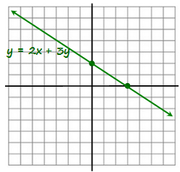
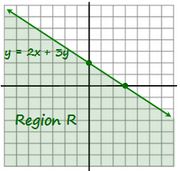
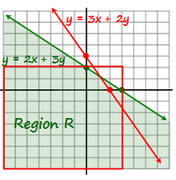
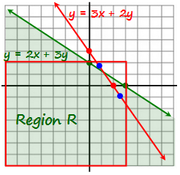
In the xy-plane, region R consists of all the points (x, y) such that 2x + 3y =< 6 . Is the point (r,s) in region R?
(1) 3r + 2s = 6
(2) r=< 3 and s=< 2
I was able to solve this simply by trial and error. The answer is E
However, when I solve it graphically, I encounter a problem.
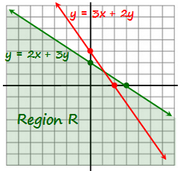
I'm able to prove statement (1) is insufficient because the graphs of 3r + 2s = 6 and 2x + 3y =< 6 don't overlap. (SEE ATTACHED GRAPH)
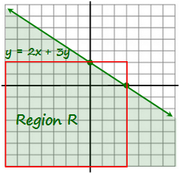
However, in statement (2) r=< 3 and s=< 2, don't the values of r and s coincide EXACTLY with the graph of 2x + 3y =< 6? I mean, if r=3 and s=2, don't r and s fall exactly ON the graph of 2x + 3y =< 6? Also if we select values of r and s that are less than 3 and 2 respectively, both r and s will lie on the LEFT of the graph of 2x + 3y =< 6.
So how is statement (2) insufficient?
Detailed explanations would be appreciated. Thanks in advance.
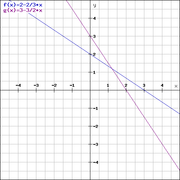
(1) 3r + 2s = 6
(2) r=< 3 and s=< 2
I was able to solve this simply by trial and error. The answer is E
However, when I solve it graphically, I encounter a problem.
I'm able to prove statement (1) is insufficient because the graphs of 3r + 2s = 6 and 2x + 3y =< 6 don't overlap. (SEE ATTACHED GRAPH)
However, in statement (2) r=< 3 and s=< 2, don't the values of r and s coincide EXACTLY with the graph of 2x + 3y =< 6? I mean, if r=3 and s=2, don't r and s fall exactly ON the graph of 2x + 3y =< 6? Also if we select values of r and s that are less than 3 and 2 respectively, both r and s will lie on the LEFT of the graph of 2x + 3y =< 6.
So how is statement (2) insufficient?
Detailed explanations would be appreciated. Thanks in advance.
Last edited by knight247 on Tue Jan 20, 2015 6:22 am, edited 1 time in total.