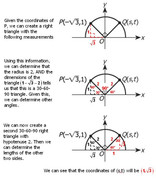
Here's one approach:

So, s = 1
Answer: B
Cheers,
Brent
1. If two lines are at 90degrees to each other, it means they are perpendicular to each other.
theCEO wrote:1. If two lines are at 90degrees to each other, it means they are perpendicular to each other.
2. Perpendicular lines have negative inverse slopes.
example line A and B are perpendicular if there slopes are (1/2) and (-2/1) respectively.
slope of OP = rise/run = 1/-sqrt(3)= -1/sqrt(3)
slope of OQ = rise/run = sqrt(3)/1
since s = x value = run; s=1
Correct - since both lines pass through the origin, the slopes can be found from each point's x and y values.nikhilgmat31 wrote:theCEO wrote:1. If two lines are at 90degrees to each other, it means they are perpendicular to each other.
2. Perpendicular lines have negative inverse slopes.
example line A and B are perpendicular if there slopes are (1/2) and (-2/1) respectively.
slope of OP = rise/run = 1/-sqrt(3)= -1/sqrt(3)
slope of OQ = rise/run = sqrt(3)/1
since s = x value = run; s=1
I agree with you as slope of OQ = sqrt(3)/1
but it is (t-0)/(s-0) = sqrt(3)/1
are you just equating the numerators & denominators ?
[email protected] wrote:Hi All,
Brent's approach to solving this question is exactly how I wouldn't have done it, so I won't rehash that explanation. Instead I'll point out the patterns and "hints" that were in the original drawing (and that you should be on the lookout for when dealing with similar questions).
1) Any time you see a diagonal line segment on a graph, you can draw a right triangle using that line as the hypoteneuse.
2) Right triangles on the GMAT are almost always pattern-based (angles or sides; at the very least, the Pythagorean Theorem). Here, we have a 1 and a √3, so we should be thinking 30/60/90.
3) Radii have the same length no matter what direction they go in.
4) Lines "add up" to 180 degrees.
GMAT assassins aren't born, they're made,
Rich

I agree Rich, two LEGS refers to sides of triangle.[email protected] wrote:Hi nikhilgmat31,
When referring to a right triangle, the word "LEGS" refers to the two 'short' sides (NOT the hypotenuse).
In this prompt, we can use the co-ordinate (-root3, 1) to create a right triangle - it will have a base of root3 and a height of 1. With those two LEGS, you can determine the measures of the two non-right angles.
GMAT assassins aren't born, they're made,
Rich