BREAKING: Target Test Prep releases Brand New 2026 On Demand GMAT prep course

Redeem

Target Test Prep · GMAT

Choose how you want to prepare

Learn live with an expert or move at your own pace. Every option includes the complete TTP study system.

★★★★★5.0559 reviews
GMATLiveTeach Starts Oct 17
Chris Peckover, Target Test Prep GMAT expert
LIVE ONLINE CLASSES

Get Ready for GMAT Test Day Faster with Live Online Classes

with Chris Peckover, 100th-Percentile GMAT Scorer

Oct 17 · Chris Peckover
Sat · 11:00 AM to 2:00 PM ET
Oct 20 · Chris Peckover
Tue, Thu · 8:00 to 10:00 PM ET
Oct 25 · Josh Braslow
Sun · 1:00 to 4:00 PM ET
Included
40 hours of live online classes + 6 months of TTP OnDemand
  • Attend the first class for free
  • Every class is recorded, so you never fall behind
View classes & enroll
Limited seats availableTarget Test Prep
EALiveTeachOnDemand 5 seats left Start anytime
EXECUTIVE ASSESSMENT

Target Test Prep EA OnDemand

Self-paced EA prep. Study on your schedule.

Logan Thompson
EXECUTIVE ASSESSMENT

Sep 6 to Dec 6, 2026

with Logan Thompson

165+ EA score guarantee
$05-day trial no automatic billing
Schedule
Sun · 9:30 AM to 12:30 PM ET
Included
40 hours of live online classes plus six months of access to the complete TTP EA OnDemand course.
  • 165+ EA Score Guarantee
  • 4,100+ Quant, Verbal, and Integrated Reasoning practice questions
  • 400+ hours of in-depth video lessons
  • 3,000+ step-by-step video solutions
View EA class & enroll Start free 5-day trial
Limited cohort · enrollment openTrial includes full course accessTarget Test Prep
GMATOnDemand Start anytime
SELF-PACED MASTERCLASS

Target Test Prep GMAT OnDemand

Complete access from day one. Study on your schedule.

715+ score guarantee
$0to start then $127/mo
  • Personalized study plan and analytics
  • Thousands of lessons and practice questions

Compare the format, schedule, and included access before enrolling. Prices and seat counts shown reflect the supplied offer details.

MGMAT Geometry

Expert replies
by rommysingh » Thu Sep 03, 2015 11:30 am
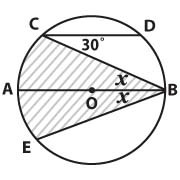
In the figure to the right, circle O has center O, diameter AB and a radius of 5. Line CD is parallel to the diameter. What is the perimeter of the shaded region?


(5/3) + 5


(5/3) + 10


(10/3) + 5


(10/3) + 10


(10/3) + 20

Image
Join the discussion
Source: — Problem Solving |

by gmatdriller » Fri Sep 04, 2015 3:43 am
Where is the diagram?
Join the discussion

by umasarath52 » Fri Sep 04, 2015 4:44 am
Since CD is parallel to AB. Angle DCB = Angle CBA = 30

Now angle CBE = 30 + 30 = 60 degree. Angle COE = 120 which is n in the length of arc formulae.

Length of an arc = n/360 x 2 x pi x radius = 120/360 x 2 x pi x 5 = 10pi/3

Angle CBA is 30 and ACB is 90. We get Right angle triangle. (Property of triangle inscribed in Circle with one of its side as diameter, opposite angle to diameter is 90 degree) and the triangle is 30-60-90 and sides will be in the ratio of 1: root 3: 2

Length of side BC is 5 root 3 = length of the side BE

Perimeter = BC+BE+arc EC

=5root3 + 5root 3 + 10pi/3

= 10 root 3 + 10pi/3

I got this answer where i don't see this in any of the options :( :( :( :(
Join the discussion

MGMAT Geometry

by Brent@GMATPrepNow » Fri Sep 04, 2015 6:15 am
As umasarath52 noted, the answer choices in rommysingh's original post are incorrect.

Below are the original answer choices.
rommysingh wrote:In the figure to the right, circle O has center O, diameter AB and a radius of 5. Line CD is parallel to the diameter. What is the perimeter of the shaded region?

A. (5/3)pi + 5√3
B. (5/3)pi + 10√3
C. (10/3)pi + 5√3
D. (10/3)pi + 10√3
E. (10/3)pi + 20√3

Image

IMPORTANT: unless stated otherwise, the diagrams in Problem Solving geometry questions are DRAWN TO SCALE.
For more on this, see our free video: https://www.gmatprepnow.com/module/gmat- ... /video/863

I'll solve this question using estimation.
Since the diameter AB = 10, we can ESTIMATE the length of CB.
It looks like CB is just a little bit shorter than AB.
So, I'll say that the length of side CB is approximately 9.
This means the length of side EB is approximately 9 as well.
Finally, arc EC looks a little bit shorter than sides CB and EB, so I'll estimate it to be length 8

So, the TOTAL perimeter = 9 + 9 + 8 = 26

Now check the answer choices:

ASIDE: On test day, everyone should know the following apprximations:
√2 ≈ 1.4
√3 ≈ 1.7
√5 ≈ 2.2
Also, we'll say that pi ≈ 3


A. (5/3)pi + 5√3 ≈ 5 + 8.5 ≈ 13.5
B. (5/3)pi + 10√3 ≈ 5 + 17 ≈ 22
C. (10/3)pi + 5√3 ≈ 10 + 8.5 ≈ 18.5
D. (10/3)pi + 10√3 ≈ 10 + 17 ≈ 27
E. (10/3)pi + 20√3 ≈ 10 + 34 ≈ 44

Of these, it appears that D is the closest.

Aside: We can see that answer choice B is pretty close too. At this point, you have a time-management decision. You can either stick with D, and use your extra time elsewhere, or your can spend time trying to be more certain of the answer. Your choice.

That said, D is the correct answer.

Cheers,
Brent
Last edited by Brent@GMATPrepNow on Sat Apr 28, 2018 9:04 am, edited 1 time in total.
Brent Hanneson - Creator of GMATPrepNow.com
Image
Join the discussion

by GMATGuruNY » Fri Sep 04, 2015 7:18 am
In the figure to the right, circle O has center O, diameter AB and a radius of 5. Line CD is parallel to the diameter. What is the perimeter of the shaded region?

A (5/3)π + 5√3
B (5/3)π + 10√3
C (10/3)π + 5√3
D (10/3)π+ 10√3
E (10/3)π + 20√3

Image
Perimeter of the shaded region = arc CAE + CB + EB.

Since AB || CD, ∠DCB and ∠CBA are congruent.
Thus, x=30, and ∠CBE = 60.

An inscribed angle is formed by two chords.
Thus, ∠CBE is an inscribed angle.
The degree measurement of an inscribed angle = 1/2 the degree measurement of the intercepted arc.
∠CBE intercepts arc CAE.
The, arc CAE = 120 degrees.
Since the entire circle = 360 degrees, the length of arc CAE = 120/360 = 1/3 of the entire circumference.
C = 2Ï€r = 10Ï€.
Thus, the length of arc CAE = (1/3)(10Ï€) = (10/3)Ï€.

The correct answer must include (10/3)Ï€.
Eliminate A and B.

Since ∠CBA = ∠ABE, the shaded sector above the diameter is congruent to the shaded sector below the diameter.
Thus, CB = EB.
Since OC=5 and AB=10, the length of CB must be between 5 and 10.
Thus, CB and EB are each between 5 and 10, implying that CB + EB is between 10 and 20.

Of the remaining answer choices, only D works:
(10/3)π + 10√3 ≈ (10/3)π + 10(1.7) ≈ (10/3)π + 17.

The correct answer is D.
Private tutor exclusively for the GMAT and GRE, with over 20 years of experience.
Followed here and elsewhere by over 1900 test-takers.
I have worked with students based in the US, Australia, Taiwan, China, Tajikistan, Kuwait, Saudi Arabia -- a long list of countries.
My students have been admitted to HBS, CBS, Tuck, Yale, Stern, Fuqua -- a long list of top programs.

As a tutor, I don't simply teach you how I would approach problems.
I unlock the best way for YOU to solve problems.

For more information, please email me (Mitch Hunt) at [email protected].
Student Review #1
Student Review #2
Student Review #3
Join the discussion

by rommysingh » Fri Sep 04, 2015 12:07 pm
Hi,
thanks for the correction and help. Do you think such question should be attempted or skipped in real time..
Join the discussion

by bschool3 » Fri Sep 04, 2015 4:56 pm
Another way to get to D

please forgive my lack of knowledge on typing math symbols, still new here.

First find length of arc CAE
We know that x = 30 deg; then 2x = 60 deg. Therefore arc CAE= (120/360)th or 1/3 of the circumference = 1/3 * 2pi*r = 1/3*2pi* 5 = 10pi/3

Secondly, we find either CB or EB and multiply by 2.
Let's pick EB. Recognize that EOB is isosceles with EO = OB, and EOB = 120 deg (given that OBE = OEB = 30 deg).
Now, a bisector of EOB would cut EB in half; let's call that half-way point Y, such that EY = YB. Focus on the triangle OYB. Recognize that the triangle OYB is a 30-60-90, with OB = 5. At this point it's just trig. We know that sin 60 = (root 3)/2 = YB/5. Therefore, YB = 5(root 3)/2. Then YB+EY =EB =5(root 3). Then EB+BC = 2* EB = 10(root3).

Then perimeter = 10(root 3)+ 10pi/3
Answer = D
Last edited by bschool3 on Fri Sep 04, 2015 5:08 pm, edited 1 time in total.
Join the discussion

by Matt@VeritasPrep » Fri Sep 04, 2015 5:07 pm
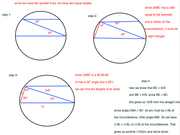
Here's a visual:

Image
Join the discussion