BREAKING: Target Test Prep releases Brand New 2026 On Demand GMAT prep course
RedeemEverything You Need to Know About the New Official Guides - Part 3
 I have now done every last one of the new Quant problems in both new booksand there are some really neat ones! Ive also got some interesting observations for you. (If you havent yet read my earlier installments, start here.)
In this installment, Ill discuss my overall conclusions for Quant and Ill also give you all of the problem numbers for the new problems in both the big OG and the smaller Quant-only OG.
Whats new in Quant?
Now that Ive seen everything, Ive been able to spot some trends across all of the added and dropped questions. For example, across both The Official Guide for GMAT Review (aka the big book) and The Official Guide for GMAT Quant Review (a.k.a. Quant-only or the Quant supplement), Linear Equation problems dropped by a count of 13. This is the differential: new questions minus dropped questions.
Thats a pretty big number; the next closest categories, Inequalities and Rates & Work, dropped by 5 questions each. Im not convinced that a drop of 5 is at all significant, but I decided that was a safe place to stop the Hmm, thats interesting! count.
Now, a caveat: there are sometimes judgment calls to make in classifying problems. Certain problems cross multiple content areas, so we do our best to pick the topic area that is most essential in solving that problem. But that 13 still stands out. :)
The biggest jump came from Formulas, with 10 added questions across both sources. This category includes sequences and functions; just straight translation or linear equations would go into those respective categories, not formulas. Positive & Negative questions jumped by 7, weighted average jumped by 6, and coordinate plane jumped by 5.
Given that Linear Equations dropped and Formulas jumped, could it be the case that they are going after somewhat more complex algebra now? Thats certainly possible. I didnt feel as though the new formula questions were super hard though. It felt more as though they were testing whether you could follow directions. If I give you a weird formula with specific definitions and instructions, can you interpret correctly and manipulate accordingly?
If you think about it, work is a lot more like this than Oh, here are two linear equations; can you solve for x? So it makes sense that they would want to emphasize questions of a more practical nature.
Anything interesting about the new questions?
In an earlier installment, I told you about some interesting problems from the big book. Here are a few more observations from the Quant-only supplemental book.
Problem Solving
Of the 176 questions in the Problem Solving (PS) section, 44 of them are new. (Disclaimer: I hope I counted correctly for all of these sections, but Ive been going through about 1,500 questions and hundreds of pages quickly in order to get this review out to you right away. So please forgive me if I miscounted anything! Ill correct any errors as soon as I find out about them.)
Note: I cant actually reproduce the text of the question for copyright reasons, but Ill cite the problem number so that you can look it up if you do decide to buy the book.
A number of questions relied on some type of pattern recognition: #125, #143, #161. Theyre not interested in you doing crazy math. Theyre interested in whether you can recognize patterns and draw some kind of meaningful conclusion.
In my notes, I labeled #80 Wow. Thats just mean. And #152 got a Pure evil tag. (#152 requires mental manipulation of a 3-D shape and thats just not something I have ever been able to do.)
Id far rather work backwards on #127 than do the actual math. Others may feel differently, but the textbook math on this one is pretty annoying.
Data Sufficiency
Of the 124 Data Sufficiency (DS) problems, 32 are new to this edition of the Quant OG. There were some doozies.
I couldnt believe #124, the highest numbered question in the section: a parabola inequality (not even an equation!). Now, if you like geometry, greatlearn how to tackle parabolas. If you dont, then if you happen to get one of these on the real test, give yourself a mental high five for earning this question, then pick your favorite letter and move on!
I almost fell into the trap on #123. Im so used to rate and work questions specifying that whatever was moving at a steady rate that I almost didnt notice the omission in this one
Also, as with the big book, I was testing cases all the time on these DS problems. That technique is just a lifesaver (and it even works on some PS problems!).
So what are all the NEW problem numbers?
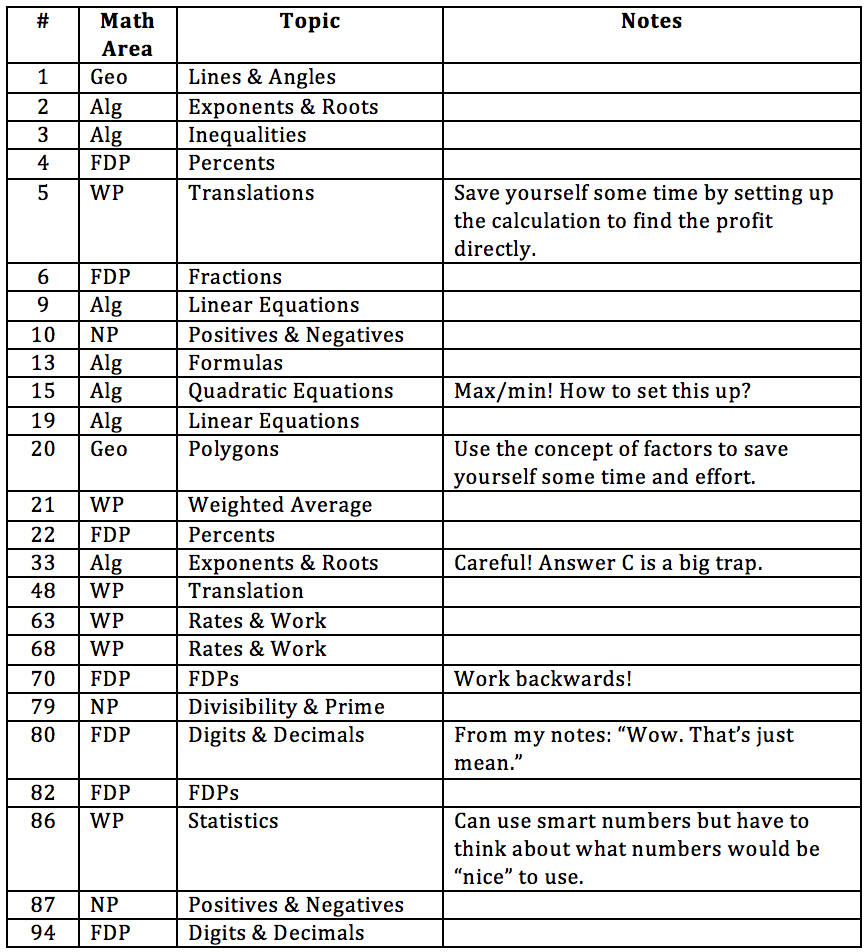
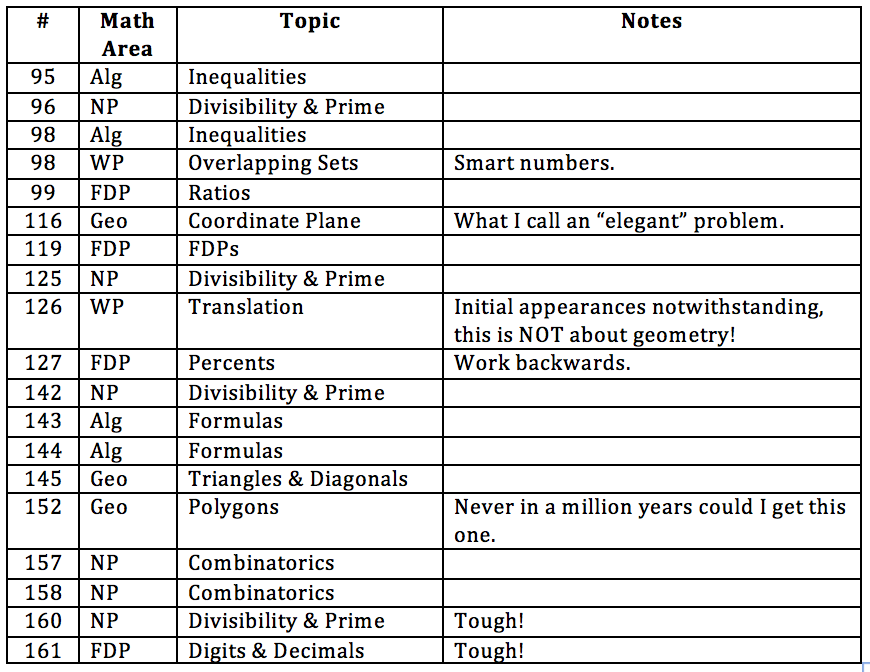
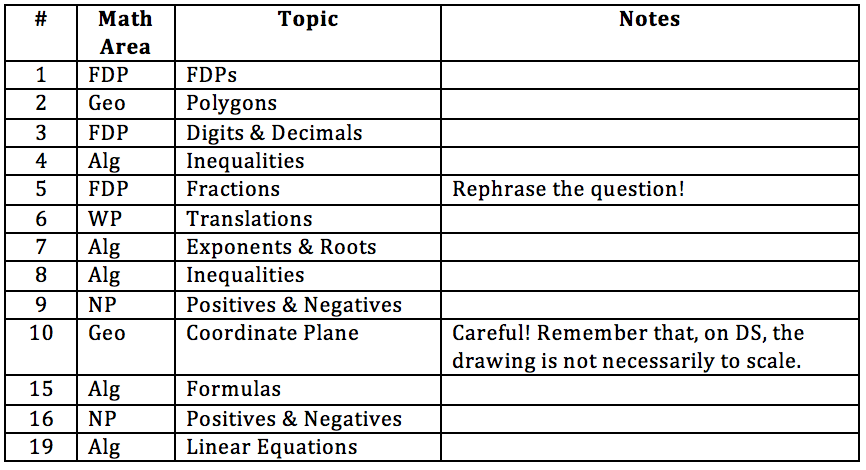
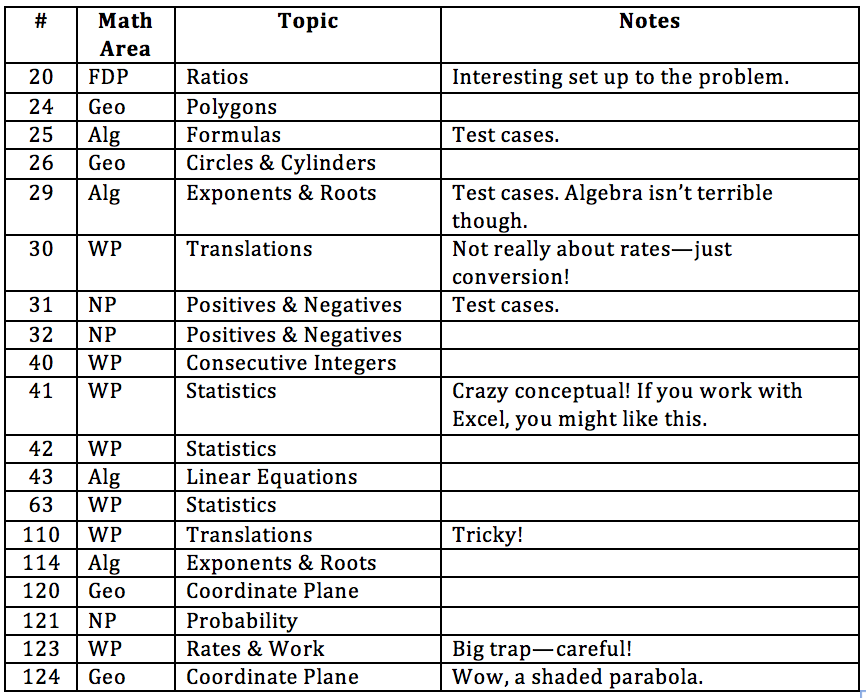
Here you go! Ive got these organized by book and question type.
The Official Guide for GMAT Review 2016, a.k.a. the big OG
Problem Solving
Key: FDP = Fractions, Decimals, & Percents; WP = Word Problems; NP = Number Properties
(note: I had to break these into multiple tables)
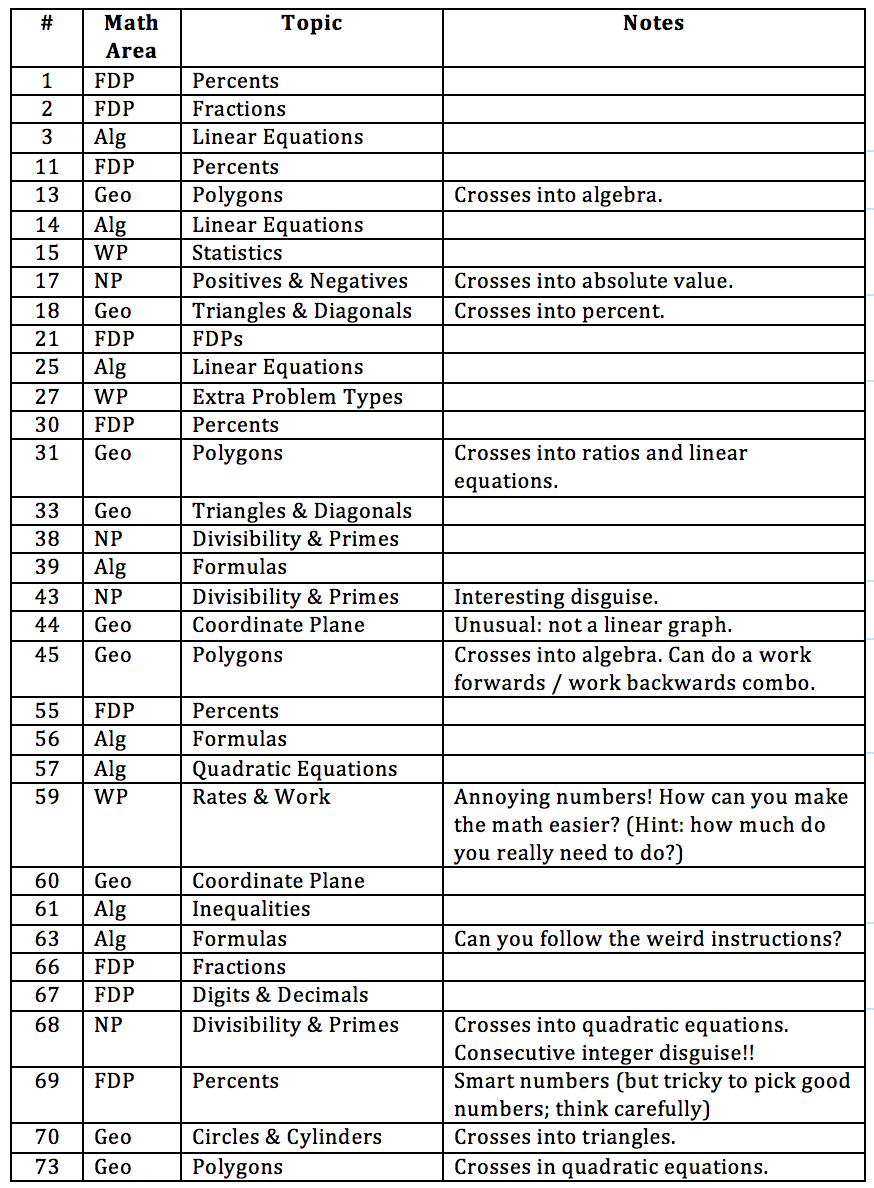
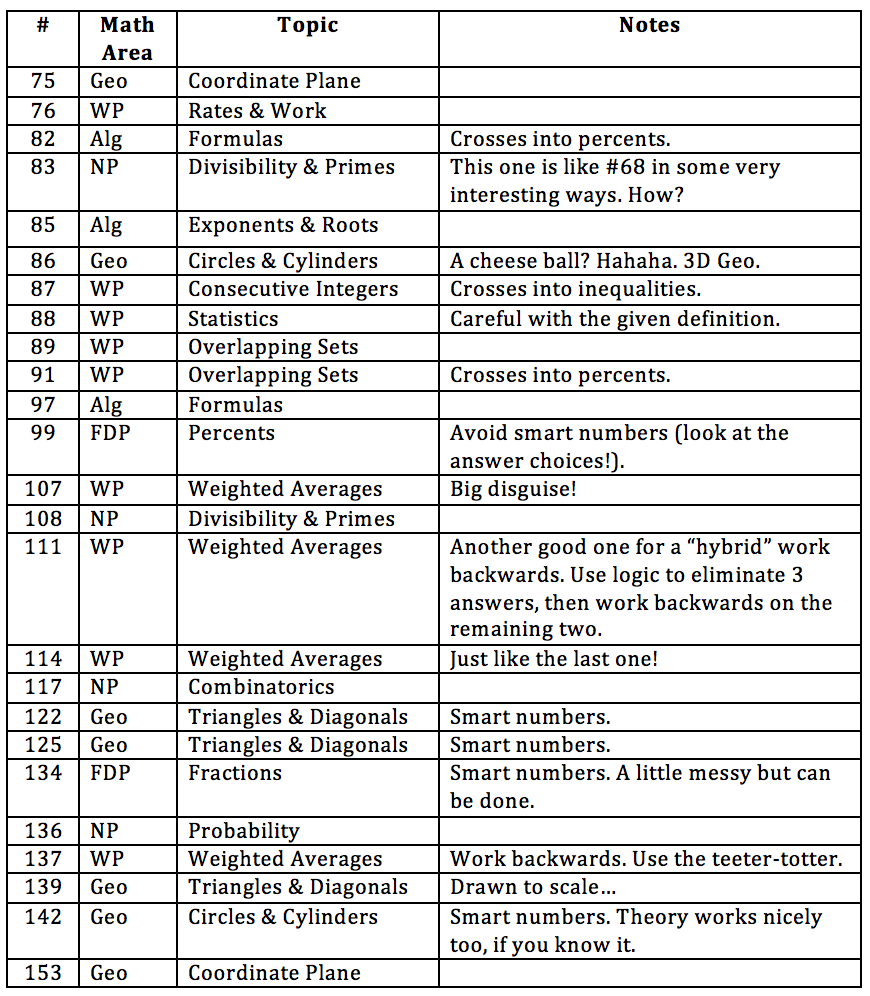
Data Sufficiency
Key: FDP = Fractions, Decimals, & Percents; WP = Word Problems; NP = Number Properties
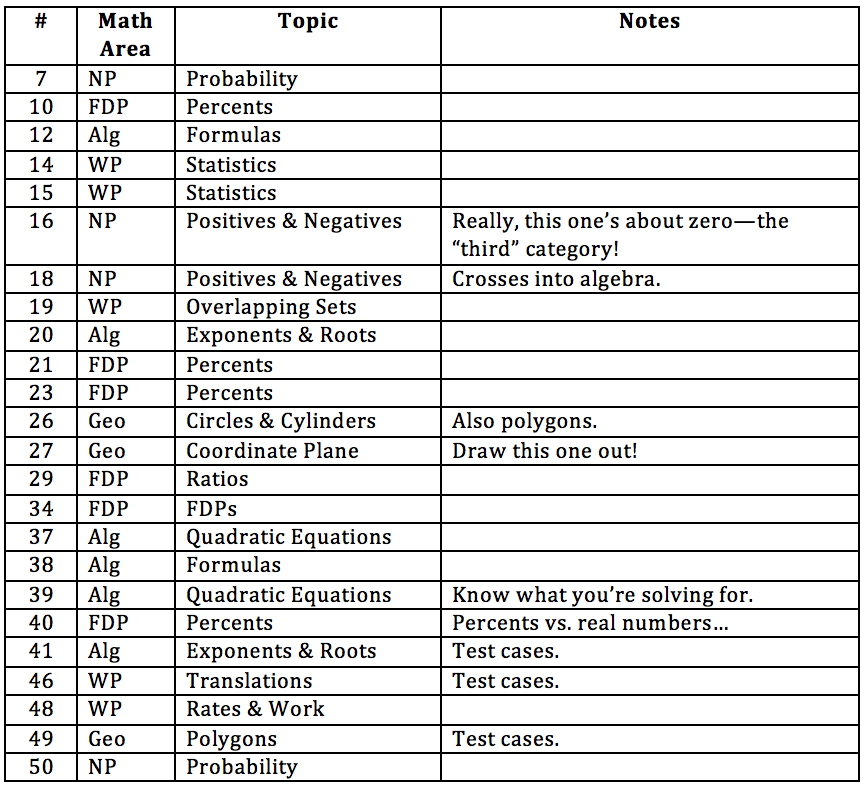
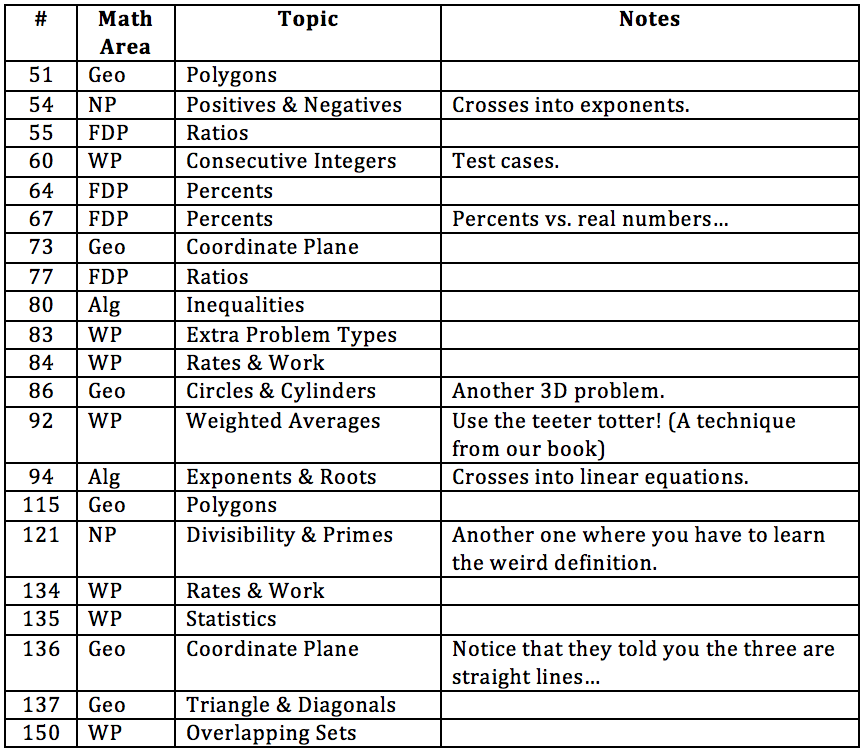
The Official Guide for GMAT Quant Review 2016, a.k.a. the Quant-only book
Problem Solving
Key: FDP = Fractions, Decimals, & Percents; WP = Word Problems; NP = Number Properties
Data Sufficiency
Key: FDP = Fractions, Decimals, & Percents; WP = Word Problems; NP = Number Properties
What about Verbal?
Next time, well dive into the final summary of everything Verbal and Ill also have the problem lists for you.
Until then, happy studying!